
Turkey’s Warning: The Emergency Never Ended
How Erdoğan turned a failed coup into authoritarian power, and why Turkey’s opposition is now fighting from prison.

This is the third installment of a series examining how democracies erode from within by examining specific countries that have gone through the process. Previously, we reviewed the introduction to the seven-step framework and Hungary’s transformation under Viktor Orbán.
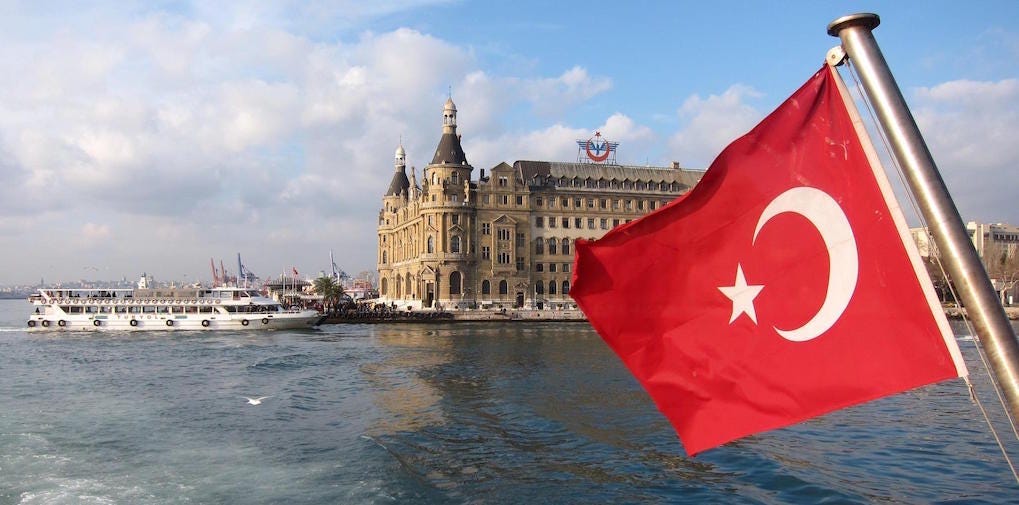
On the morning of July 16, 2016, Recep Tayyip Erdoğan stood before television cameras and described the previous night’s failed military coup as “a gift from God.”
Tanks rolled through Istanbul. Fighter jets had bombed the parliament building in Ankara. Over 250 people were dead, more than 2,000 injured. Civilians had stood in front of armored vehicles with nothing but their bodies and their phones, and they won. The coup had failed within hours.
By the next morning, before the smoke had cleared from the parliament grounds, Turkish authorities arrested 2,745 judges. Not soldiers or officers who had driven the tanks… Judges.
The government had names ready, printed on lists, organized by court and jurisdiction. Within five days, over 45,000 people had been arrested or suspended from their positions, including 15,000 teachers, 163 generals (nearly half the military’s senior leadership), and every university dean in the country.
You don’t compile lists that detailed, organized, and far-reaching, in just a weekend.
You compile them in advance and wait for the moment to use them. A coup attempt begins on a Friday evening and by Saturday morning the president calls it a gift.
By Monday morning, tens of thousands of people across every sector of government, people who had nothing to do with tanks or fighter jets, are being pulled from their jobs and, in many cases, their homes.
Imagine your neighbor tells you there was a break-in on their street last night, and by the next afternoon they’ve already installed a full security system, rewired their house, changed every lock, and added cameras covering the entire block. You wouldn’t think, “Wow, they responded fast.” You’d think they’d been planning this renovation for months.
Turkey was a democracy.
It was a flawed one, with a history of military interventions, but it held competitive elections, maintained an independent judiciary, and was actively negotiating EU membership.
Freedom House rated it “Partly Free.”
Today, Freedom House rates Turkey “Not Free,” a designation it has held since 2018. The country has dropped 22 points on Freedom House’s democracy index since 2014, placing it alongside Venezuela among the nations with the steepest declines in the world. Reporters Without Borders ranks Turkey 163rd out of 180 countries for press freedom. At least 90 percent of national media is under government control.
The leading opposition presidential candidate is in prison, where he has been for over a year, facing charges that could carry a sentence of more than 2,300 years.
His trial began in March 2026 inside the prison complex, severely restricted.
Step 1. Win Power
Erdoğan co-founded the Justice and Development Party (AKP) in 2001 and became prime minister in March 2003.
The early years looked like democratization:
His government abolished the death penalty, expanded healthcare, and pursued EU-endorsed reforms that broadened civil rights for ethnic and religious minorities. For the first time in modern Turkish history, the Jewish community was allowed to celebrate Hanukkah publicly. Non-Muslim foundations received properties that the state had previously confiscated. International observers praised the changes. The EU continued accession negotiations.
Many of these reforms improved people’s lives. However, they also served a strategic purpose. The EU-endorsed changes that limited military power removed the one institution that had historically checked civilian overreach in Turkey. The military had intervened in Turkish politics four times since 1960, and however anti-democratic those interventions were, the officer corps functioned as a structural counterweight.
Between 2007 and 2012, a series of high-profile trials (the Ergenekon cases) purged secularist officers from senior positions, replacing them with loyalists. By the time the AKP was firmly established, the institution that might have pushed back was already hollowed out.
Think of it the way you’d think about a workplace:
A new CEO arrives and starts by restructuring the internal audit department, reassigning cases, and replacing staff with people who owe their positions to the new leadership. Each individual change looks reasonable but after a few years, the audit function exists on paper while reporting to the people it’s supposed to be auditing.
Step 2. Manufacture a Crisis
The AKP didn’t manufacture the 2016 coup attempt.
Elements of the military, many linked to the Gülen movement (a former Erdoğan ally turned rival), genuinely tried to overthrow the government, and people died.
The government declared a state of emergency on July 20, 2016.
Under Turkish law, it lasts three months.
The government extended it seven times, keeping it in place for two full years.
During that period, Erdoğan governed by executive decree, bypassing parliament entirely. More than 30 emergency decree-laws were issued, granting sweeping authority to dismiss, detain, and prosecute anyone deemed connected to the plotters or, increasingly, to any form of opposition.
By November 2016, more than 34,000 people had been arrested and over 105,000 civil servants dismissed. More than 6,000 academics lost their jobs. Over 20,000 teachers were fired. More than 2,000 educational institutions were closed. The government shut down 186 media outlets and arrested 142 journalists. Over 1,000 university lecturers who had signed a petition criticizing military operations months before the coup were prosecuted for “insulting the Turkish state.” Owning a book written by Fethullah Gülen was treated as sufficient evidence of terrorist affiliation.
The coup attempt involved a faction within the military:
The purge reached into every classroom, newsroom, courtroom, and faculty lounge in the country. Over one-fifth of Turkey’s entire judiciary was removed. The New York Times and The Economist described it as a “counter-coup.”
Step 3. Name a Scapegoat
The Gülen movement became Turkey’s scapegoat.
The government designated it as FETÖ (Fethullahist Terror Organization) and treated any prior contact with the movement, which had operated legally for decades, as evidence of terrorism. Teachers, businesspeople, judges… the definition of complicity expanded until it could reach almost anyone.
But the scapegoat was not limited to the Gülen movement.
Members of the pro-Kurdish Peoples’ Democratic Party (HDP) were arrested, including the party’s co-chairs and multiple members of parliament.
Elected mayors in Kurdish-majority cities were replaced with government-appointed trustees. When Erdoğan campaigned for the 2017 constitutional referendum, he accused opponents of being “LGBT-ist” and of being controlled by Kurdish militants. The scapegoat had expanded from one cleric in Pennsylvania to encompass anyone who disagreed.
Step 4. Expand Executive Power
On April 16, 2017, while the country was still under the state of emergency, Turkey held a constitutional referendum.
The proposed amendments abolished the office of prime minister, replaced the parliamentary system with an executive presidency, gave the president power to issue decrees with the force of law, eliminated parliament’s ability to hold a vote of no confidence, and allowed the president to appoint the majority of the judiciary directly or indirectly. The president would no longer be required to be neutral or above party politics.
The referendum passed with 51.4 percent of the vote.
The Supreme Electoral Council allowed ballots without official stamps to be counted as valid. European monitors said the vote did not meet international standards. The Venice Commission called the amendments “a threat to democracy.”
The changes took full effect after snap elections in June 2018. The state of emergency was technically lifted on July 18, but the parliament immediately passed a new law preserving most of the emergency powers for three more years. The head of the opposition’s parliamentary faction, Özgür Özel, said what had happened plainly: “They make it look like they are lifting the emergency but in fact they are continuing it.”
The International Commission of Jurists said the rule of law in Turkey had been “effectively trapped in limbo.”
Step 5. Attack Courts and Press
With over one-fifth of all judges and prosecutors removed after the coup, the government filled the vacancies with loyalists.
The constitutional referendum then gave the president direct appointment power over the Supreme Board of Judges and Prosecutors.
European Judges for Democracy and Liberty have stated that the justice system is not independent and that Turkey has “many examples of arbitrary justice and of unlawful detention.”
The media followed the same trajectory. Erdoğan’s approach operated through financial pressure and strategic ownership transfers.
Media companies that criticized the government faced tax investigations and advertising boycotts.
Companies that aligned with it received lucrative public contracts in construction and energy. The result is a landscape dominated by conglomerates whose media operations are subsidized by government-connected revenue.
In 2018, Turkey’s largest independent media group, Doğan, was sold to an Erdoğan ally for roughly $1 billion. The outlets had been relatively independent. After the sale, they fell in line.
Journalist Kadri Gürsel, who was recently released from prison at the time, wrote that “the Turkish mass media industry comes under the direct political control of President Erdoğan.”
By 2025, at least 90 percent of national media was under government control.
Turkey had become the world’s largest jailer of journalists.
The government seized several of the last remaining independent outlets, including Sözcü, HaberTürk, and Tele1. RSF noted that self-censorship had become “a new social norm across society.”
Step 6. Destroy Internal Accountability
The 2017 amendments stripped parliament of its ability to hold a vote of no confidence.
Impeachment required a two-thirds supermajority, a practical impossibility.
The last government spending audit made public was in 2012-2013, after that, the government just stopped releasing them. The presidency assumed direct control over all ministries.
Elected mayors in opposition-held cities were removed from office and replaced with government trustees.
This practice, which began in Kurdish-majority cities, expanded after the opposition CHP swept municipal elections in 2024.
Rather than accept the results, the government launched criminal investigations against hundreds of opposition officials.
Step 7. Normalization
Turkey still holds elections.
Erdoğan has won them repeatedly, including a tight victory in 2023. Opposition parties still exist and occasionally win, particularly at the municipal level, where the CHP swept major cities in both 2019 and 2024.
People can still protest, though at significant personal risk.
Now in Turkey each step in the transformation had a plausible justification. The coup happened, so the emergency was justified. The Gülen movement was a genuine threat, so the broad definition of complicity was appropriate. The parliamentary system was inefficient, so the presidential system was a modernization. Each explanation is reasonable if you look at it alone. The strategy only looks obvious when you look at all of it, together.
In the United States, the current administration has fired inspectors general across multiple federal agencies.
Federal judges have issued orders that the administration has defied. The press faces escalating hostility from officials who describe critical coverage as an enemy of the state. Executive orders have been used to bypass congressional authority on spending, immigration enforcement, and federal workforce reductions.
Turkey used a failed coup.
The United States uses immigration, trade policy, and executive authority disputes.
Crisis ‘justifies’ emergency action, emergency action becomes standard practice, and standard practice becomes the norm.
In Hungary, Orbán built his system from within democratic institutions, bending them gradually until they served his purposes while still appearing functional.
In Turkey, Erdoğan used a genuine external shock to shatter the system’s constraints in a matter of weeks and then spent years making the shattered state permanent. Both paths lead to the same destination, but Turkey shows how quickly an emergency can become a constitution.
What Turkey’s Opposition Did
And then came Ekrem İmamoğlu.
İmamoğlu was a relatively unknown local politician when he ran for mayor of Istanbul in 2019.
He won.
Erdoğan’s party arranged for the election to be annulled and rerun. İmamoğlu ran again and won by a larger margin, turning Erdoğan’s attempt to erase the result into a demonstration of how badly it could backfire.
İmamoğlu governed Istanbul as a competent, visible, accessible mayor.
He won reelection in 2024 with an even stronger mandate as the CHP swept municipal elections across the country.
He became the opposition’s most credible challenger for the 2028 presidential race…
However,
On March 18, 2025, Istanbul University annulled İmamoğlu’s undergraduate diploma, citing irregularities in a transfer from 1990, thirty-five years earlier. Under Turkish law, presidential candidates must hold a university degree.
The next morning, March 19,
police surrounded İmamoğlu’s home at dawn and detained him along with more than 100 associates, including two district mayors, journalists, and business figures.
The charges included corruption, bribery, money laundering, espionage, and aiding the PKK.
İmamoğlu was formally arrested on March 23 and sent to Silivri Prison.
The Interior Ministry suspended him from office.
The prosecution’s indictment named 402 people and demanded a sentence of over 2,300 years.
His construction company was seized.
His lawyer was arrested.
His wife’s brother was arrested.
His campaign manager was arrested and later told reporters from prison that the judiciary had been “transformed into one of the central tools of political maneuvering.”
The Council of Europe, the European Parliament, and Human Rights Watch all condemned the detention.
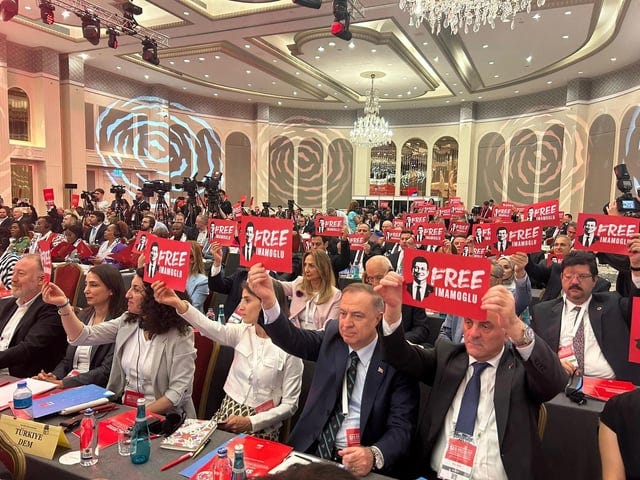
But on the same day İmamoğlu was sent to prison, the CHP held his presidential primary anyway.
Over 15 million people voted for him, including 13 million non-party members casting symbolic ballots at improvised polling stations.
The protests that followed were the largest Turkey had seen since 2013.
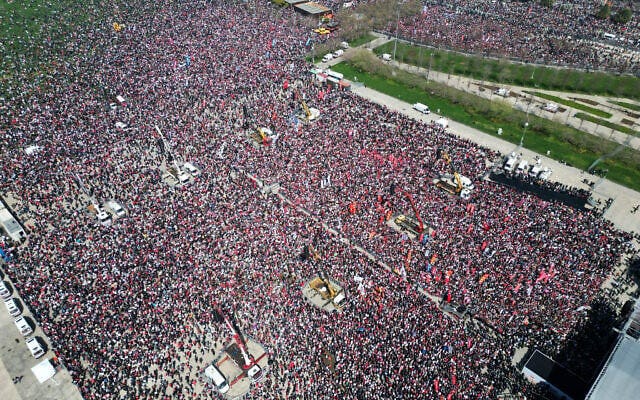
Police responded with tear gas, water cannons, and rubber bullets.
The government throttled social media for 42 hours.
The Turkish lira dropped 16.3 percent in three days. The Brookings Institution’s Turkey Project director noted that unlike the 2013 Gezi protests, which were leaderless and driven by secular urban professionals, the 2025 protests were more organic, younger, and included a significant number of retirees.
One year later, İmamoğlu remains in prison.
His trial began inside the Silivri prison complex in March 2026, severely restricted.
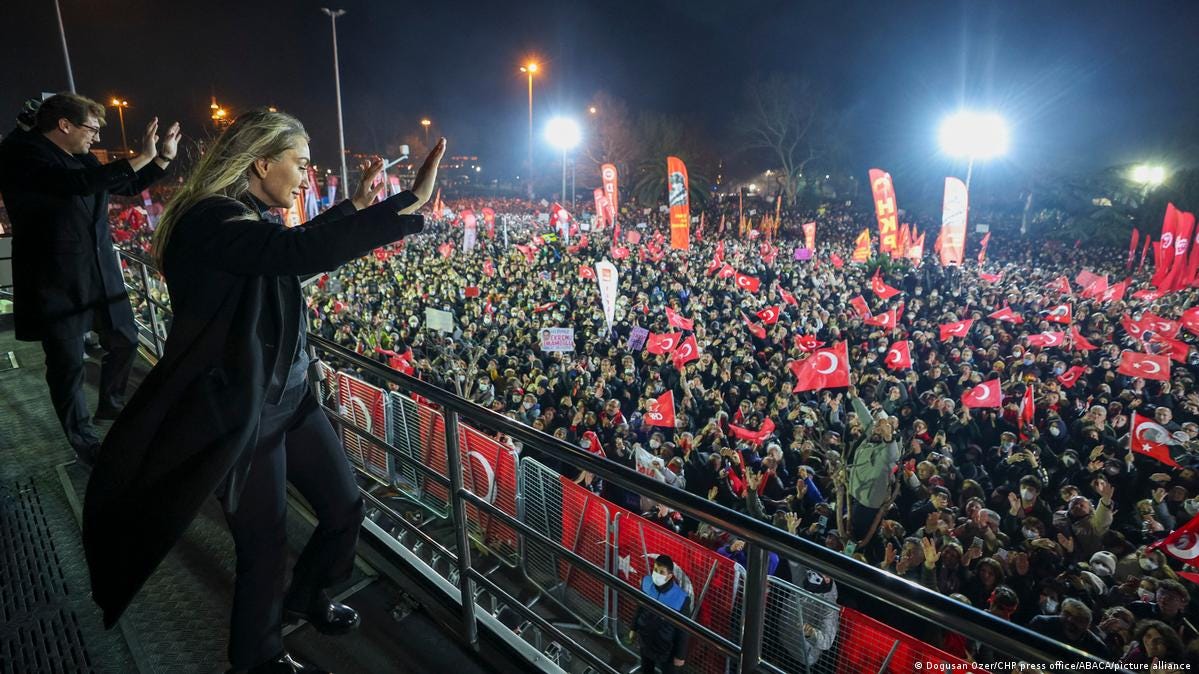
Dilek İmamoğlu (his wife) addressed a rally of thousands on the anniversary of his detention, telling the crowd that “the day the government decides its opponents is the day democracy dies.”
What Turkey Teaches Us
A three-month state of emergency was extended seven times over two years.
During that emergency, a constitutional referendum eliminated parliamentary oversight and created an executive presidency.
When the emergency was technically lifted, a new law preserved its powers for three more years.
When that law expired, it was extended again.
The emergency became the system, and the system became permanent.
Every step had a justification:
The emergency powers? We just survived a coup.
Dismissing 130,000 civil servants? They were Gülen sympathizers.
Rewriting the constitution during a state of emergency? The people voted for it.
Jailing journalists? They were propagandists for terrorists.
Arresting the opposition’s presidential candidate? He’s corrupt, and the judiciary is independent.
Each defense sounds reasonable.
Each one asks you to evaluate a single action in isolation, without considering what came before it or what it makes possible next.
The opposition in Turkey is not dead.
The CHP won every major city in 2024, and fifteen million people voted for a man in a prison cell.
Protests continued for months despite a police crackdown, and Dilek İmamoğlu still speaks to crowds of thousands.
European pressure is happening, too.
Germany reportedly stalled a major Eurofighter sale after İmamoğlu’s arrest, though that block later softened as arms negotiations continued.
But the reality is that Erdoğan controls the judiciary that will decide İmamoğlu’s fate, the media that shapes public perception of his trial, the parliament that can’t hold the executive accountable, and the security forces that police the protests.
The opposition has the people.
The government has the institutions.
İmamoğlu’s trial is ongoing.
He faces over 2,300 years in prison.
The next presidential election is scheduled for 2028, and the man polling best against Erdoğan is sitting in a cell in Silivri because he won three elections against the person who thinks he owns Istanbul.
Whether the people or the institutions prevail is not a question Turkey faces alone.
Subscribe to be notified when the next post in this series is published. Next, we’ll examine Argentina and what it teaches us about authoritarian power.
How long can elections protect a country when the institutions around them no longer do?
Sources
“2016 Turkish coup d’état attempt,” Wikipedia.
“Purges in Turkey following the 2016 Turkish coup attempt,” Wikipedia.
“Turkey crackdown by the numbers,” Amnesty International, July 2016.
“World Report 2017: Turkey,” Human Rights Watch.
“From purges to a ‘new Turkey,’” OSW Centre for Eastern Studies, December 2016.
“2016 Country Reports on Human Rights Practices: Turkey,” U.S. State Department.
“The Turkish constitutional referendum, explained,” Brookings Institution, April 2017.
“Questions and Answers: Turkey’s Constitutional Referendum,” Human Rights Watch, April 2017.
“2017 Turkish constitutional referendum,” Wikipedia.
“Turkey: Normalizing the State of Emergency,” Human Rights Watch, July 2018.
“Years of emergency decrees still impact rights and freedoms,” OMCT, 2022.
“Two years after failed coup, Turkey ends state of emergency,” France 24, July 2018.
“Erdogan Takes Total Control of ‘New Turkey,’” CSIS, July 2018.
“Türkiye: ten years of state hostility towards the press,” Reporters Without Borders, August 2024.
“Erdogan Ramps up Drive to Silence Turkey’s Last Independent Media,” Balkan Insight, December 2025.
“Turkey’s largest media group set for sale to Erdogan ally,” Times of Israel / AP, March 2018.
“Political Affiliations,” Media Ownership Monitor Turkey.
“Economy,” Media Ownership Monitor Turkey.
“Turkey: Freedom in the World 2026,” Freedom House.
“Arrest of Ekrem İmamoğlu,” Wikipedia.
“How has Turkey changed after İmamoğlu’s arrest?” Brookings Institution, April 2025.
“2025 Turkish protests,” Wikipedia.
“Protests continue for a fifth night after court orders Imamoglu jailed,” Euronews, March 2025.
“Istanbul Mayor Imamoglu imprisoned, pending trial,” Al Jazeera, March 2025.
“The Arrest of Ekrem Imamoglu: A Critical Turning Point,” Arab Center Washington DC, March 2025.
“İmamoğlu trial, the press under pressure,” Osservatorio Balcani Caucaso Transeuropa, March 2026.
“The End of Erdogan,” Foreign Affairs, June 2025.
“After Erdogan: Who Will Control Turkey?” FDD, February 2026.
“Turkey After Erdogan,” FDD, March 2023.
“Turkey’s election: Erdogan built vast power for 20 years,” NPR, May 2023.
“Turkey: Freedom on the Net 2025,” Freedom House.
“Turkey extends ‘undeclared state of emergency,’” bne IntelliNews, July 2021.
Never forget that the Climate Crisis is still ongoing.
I just got some jewelry with purpose like earrings that say, resist and a necklace that says, Not Today fascist. It’s ongoing and we must stand together