


Help us grow our social media presence so we can reach more people, this channel is dedicated to No Kings News and Media. Follow us on Instagram:
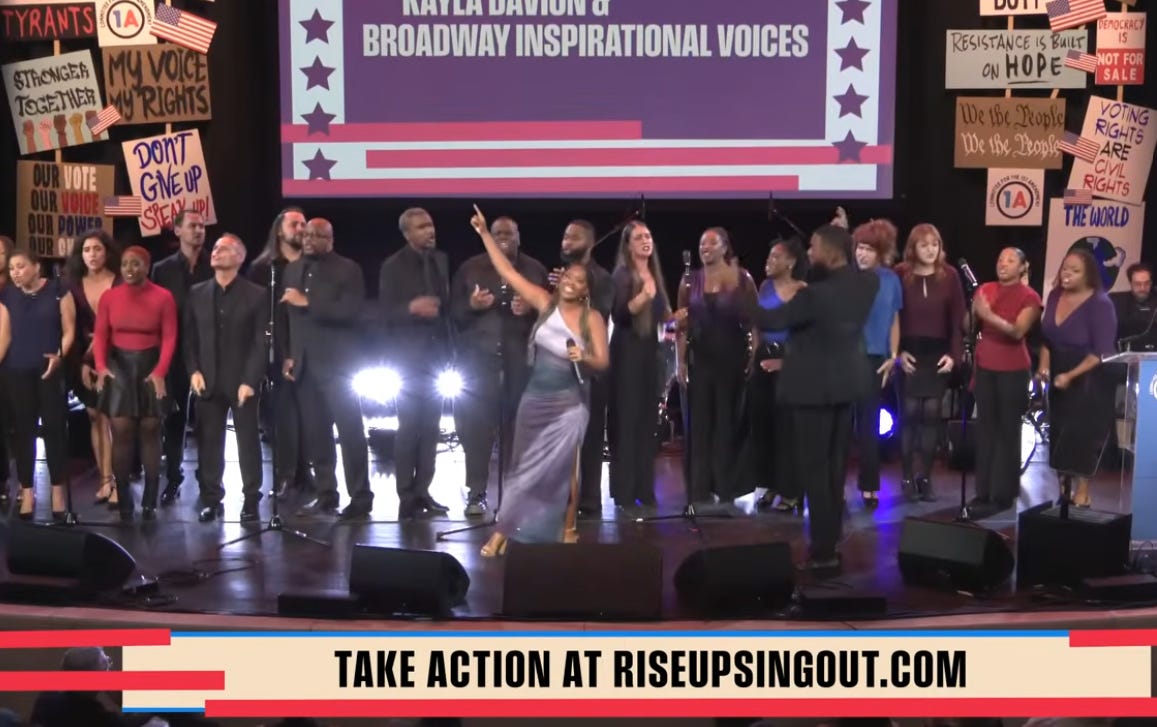
The June 14 First Amendment event brought together artists, organizers, faith leaders, librarians, journalists, performers, and local watch parties across the country to remind us that fascism grows through fear and isolation, while democracy survives through community, courage, culture, and organized people power.
On June 14, as the country moved closer to its 250th anniversary, Rise Up, Sing Out: A Concert for the First Amendment offered a very different picture of patriotism than the one being pushed by the Trump administration, instead of asking people to rally around Trump, the event asked people to gather around the freedoms that are supposed to belong to all of us: speech, religion, press, assembly, protest, and expression.
The concert was presented by the Committee for the First Amendment at The Town Hall in New York City as a 90-minute evening of “song, solidarity, and action,” with all proceeds benefiting the Committee’s work, and the venue itself described the night as a celebration of First Amendment freedoms at a moment when fundamental rights are under threat.
The program included major public figures such as Jane Fonda, Patti Smith, Bette Midler, Robert De Niro, Julia Roberts, Joy Reid, Lily Gladstone, Tessa Thompson, LaTosha Brown, Peppermint, Wilson Cruz, Rufus Wainwright, Sasha Allen, Broadway Inspirational Voices, faith leaders, librarians, and organizers.
For No Kings, the most important part of this event was not only what happened on the stage in New York, but what happened around the country. No Kings and Indivisible partnered with the Committee for the First Amendment to turn the concert into a nationwide organizing moment built around local watch parties, relationship-building, and community action.
No Kings described the event as “A Concert for the First Amendment” and “An Evening to Build Community,” while explaining that the point was to build the durable, hyper-local infrastructure needed to counter authoritarian spectacle with people power, shared food, art, local connection, and meaningful action.
No Kings framed the June 14 organizing day as a way to transform the energy of mass street mobilizations into sustained local power, with people gathering in living rooms, community centers, local businesses, congregations, and civic spaces to connect with one another and prepare for the fights ahead.
The message: authoritarianism attacks pressure points, while movements defend the whole ecosystem
The strongest takeaway from Rise Up, Sing Out was that authoritarianism doesn’t usually announce itself by saying it’s ending democracy; instead, it tests pressure points across society, weakens one institution at a time, isolates one community at a time, and trains the public to accept each new violation as if it were separate from the last.
That’s why the event moved through so many connected themes: media capture, censorship, book bans, immigrant detention, trans rights, religious freedom, voting rights, Indigenous survival, protest, grief, art, and collective action.
Jane Fonda and the Committee for the First Amendment placed this moment inside a much older warning
The opening of the event connected today’s First Amendment fight to the original Committee for the First Amendment, which was formed during the McCarthy era when Hollywood artists and writers were targeted, blacklisted, and treated as enemies for their political beliefs.
The introduction explicitly referenced Congress turning its sights on Hollywood, the Hollywood Ten, the blacklisting that followed, and the argument that arbitrary standards of “Americanism” were themselves disloyal to the spirit and letter of the Constitution.
The authoritarian tactics we see today are familiar, accuse dissenters of being dangerous, make artists afraid to speak, make institutions comply before they are forced to, and redefine patriotism until it means obedience instead of democratic participation.
Fonda’s remarks gave the night a clear moral frame when she argued that this is not fundamentally about Democrat versus Republican or left versus right, but about right versus wrong, because the freedoms protected by the First Amendment can’t only be defended when they belong to people we already agree with. She emphasized that rights are for everyone, that people should not be attacked or called terrorists for exercising constitutional freedoms, and that Americans across the political spectrum who care about freedom have a responsibility to stand up.
The event used music as a way to organize
One of the reasons the night worked so well as a movement event is that music was not treated as a break from politics, but as one of the oldest tools people have used to build courage, memory, discipline, and solidarity inside movements. Fonda said that nothing brings people together more powerfully than music, and connected protest songs to the long history of civil rights organizing, arguing that when people listen to a protest song, they don’t only hear the words, but feel the message.
The night’s musical choices, from Sasha Allen’s performance to Bette Midler’s updated version of Woody Guthrie’s “All You Fascists Bound to Lose” to Patti Smith closing with “People Have the Power,” created a through-line between older freedom struggles and the present fight against authoritarianism. The event included performances by Rufus Wainwright, Patti Smith, and Bette Midler, with Fonda pointing to widespread livestream participation and watch parties across the country.
Lily Gladstone gave the night one of its strongest organizing metaphors: face the storm together
Lily Gladstone’s section grounded the event in Indigenous survival, land, memory, and the long history of communities that have already endured state violence, stolen speech, broken promises, forced removal, and attempts at erasure. Her remarks moved from the land and Native presence in what is now New York to the teaching of the buffalo, especially the image of the herd turning toward the blizzard together instead of scattering in fear.
If we only consume frightening news from phones and the media, we become easier to demoralize, but when we sit in a room with our neighbors, sing together, talk through what’s happening, share food, make plans, and leave with one concrete next step, fear loses some of its control.

Joy Reid’s speech taught us that media capture is a First Amendment emergency
Joy Reid’s focused on one of the most urgent and technically important threats of this moment: the capture and intimidation of the press. She warned about corporate media bending under pressure, billionaires consolidating local stations, newspapers, and national networks, and powerful interests attempting to control what people are allowed to hear.
This is not only a “media industry” problem, because a public that can’t access accurate information can’t fully exercise democratic power. When newsrooms are intimidated, when ownership becomes more concentrated, when journalists are punished for challenging power, and when entertainment and news companies make political concessions to protect their business interests, the First Amendment may still exist on paper while its practical function weakens in daily life. This is why one of the event’s official calls to action asked people to tell their state attorneys general that they oppose corrupt capture of the media, and the Rise Up Sing Out action page directed supporters to petition or call their AG.
For No Kings readers, this is one of the places where the fight becomes very concrete, because defending democracy is also protecting the information distribution that makes meaningful voting, protest, organizing, and public accountability possible.
Libraries and book bans showed how censorship begins quietly and bureaucratically
The section with Sam Helmick and Maggie Tokuda-Hall was one of the clearest examples of how First Amendment fights show up in everyday public life, because libraries are some of the last public spaces where people can encounter unfamiliar voices, complicated histories, and neighbors they may not yet understand. Helmick described libraries as places where communities meet different perspectives, while Tokuda-Hall described being asked to remove the word “racism” from her work and then realizing that book bans were a form of harm that was ruining people’s lives.
Authoritarianism often begins by narrowing language before it openly attacks people. If the word “racism” becomes too controversial to name, then the history of racism becomes easier to erase, and if certain books are removed from schools and libraries, then the people reflected in those stories are quietly told that their lives are too dangerous, too political, or too inconvenient for public understanding. Tokuda-Hall’s line that it’s not the government’s place to tell people what they get to read should become a simple test for every school board, legislature, and official trying to dress censorship in the language of “protection.”
Share your favorite banned book & why in the comments:
Immigrant children reminded the audience that cruelty is normalized when we look away
The event’s section on family detention and separation brought the moral stakes of authoritarian government into the room with unusual force, because it refused to let immigrant children become statistics, abstractions, or political talking points. The speakers said plainly that children belong in schools and playgrounds, not detention centers, and includes testimony about babies, toddlers, and children held behind wire, children struggling to get food and medicine, and a 14-year-old named Ariana describing being separated from her siblings and losing school, family time, and the peace of mind every child deserves.
A government that can cage children, separate families, and delay medical care is teaching the public to accept this hierarchy as “normal”.
The hopeful part is that the section didn’t end in despair, because the performers led the audience in a song written with children inside detention, turning testimony into collective witness and asking the room to sing as if their voices could break down the walls of detention centers.
The Pride and trans rights : Connecting visibility to democracy
Peppermint and Wilson Cruz brought Pride, trans rights, public visibility, and LGBTQ+ safety into the First Amendment frame with both joy and urgency. Peppermint spoke as a trans woman about growing up hidden, finding truth through music, and living in a time when the spotlight is dangerous for many trans people, while Wilson Cruz connected Pride to public spaces, rainbow flags, crosswalks, monuments, and the right to be seen without shame.
Authoritarian movements often target trans people and queer communities because they’re convenient targets for fear politics. Their strategy is to make one group’s existence seem controversial, use that controversy to distract from government failure, and then normalize the idea that some people’s rights can be negotiated away for political convenience.
The response offered from the stage was joyful but also strategically serious: if they lower the flag, raise it again, and if they paint over the rainbow, paint it brighter.

Faith leaders clarified that religious freedom is not the same thing as religious domination
Featuring Rabbi Rachel Timoner, Dr. Hussein Rashid, and Rev. Adriene Thorne, reminded the audience that the First Amendment’s religion clauses protect both the freedom to practice faith and the freedom from having the government impose one religious vision on everyone else.
This helped explain why defending church-state separation is not anti-faith, but pro-freedom, because the same government powerful enough to privilege one faith today is powerful enough to punish another tomorrow.
Robert De Niro and LaTosha Brown gave the room both anger and direction
Robert De Niro’s section was blunt, angry, and intentionally unsanitized, it served an important role, many people are exhausted by being told that outrage is the problem when the actual problem is cruelty, corruption, and authoritarian power. De Niro’s remarks became one of the most forceful parts of the night, while the event as a whole addressed issues ranging from Indigenous rights and LGBTQ+ protections to detained children and religious freedom.
LaTosha Brown then gave that anger direction by tying freedom songs to the long struggle for Black voting rights, especially in the South, and warning that tactics tested against Black voters, Southern communities, and marginalized people rarely stay confined to one region. She warned that silence has never been neutral, that inaction is not a strategy, and that real change in this country has never come from the White House alone, but from the people who organize, imagine, and build something better together.
The closing calls to action
The most important thing about Rise Up, Sing Out is that it ended by asking people to do something useful with hope.
The official action page directed people to:
Oppose corrupt media capture by contacting their attorney general
Volunteer with the nonpartisan Election Protection Coalition’s 866-OUR-VOTE hotline
Become a poll worker through Power the Polls
Follow Singing Resistance
Support Broadway Inspirational Voices
And stay connected with the Committee for the First Amendment
And because this event was bigger than any one speaker or name:
We also want to honor the wider chorus of people who carried the night and helped turn it into something larger than a stage performance.
Tessa Thompson brought one of the night’s most necessary moral through-lines, connecting the memory of George Floyd, the grief and rage of state violence, and the right of people to exist and speak out against the government without being punished for it; Julia Roberts followed by slowing the room down into a moment of breath, hope, and responsibility before honoring Renée Nicole Good with words written by Amanda Gorman; and the night also held space for Alex Pretti, whose life and death were named as part of the same urgent call to face state violence without letting grief become numbness.
We also want to recognize Broadway Inspirational Voices, Rude Mechanical Orchestra, Singing Resistance New York, Singing Resistance Twin Cities, Brass Solidarity from George Floyd Square, the young performers who helped carry “Sing Down These Walls,” the house band, the BIV Band, the additional vocalists and musicians, the ASL interpreters, the production crew, the video and livestream team, the national watch-party organizers, the Committee for the First Amendment staff, and every local host and community member who gathered across the country. Collective presence makes a big difference.
The big takeaway for No Kings
The real lesson of Rise Up, Sing Out is that the First Amendment is not self-executing, because speech, press, protest, religion, assembly, and expression do not defend themselves just because they’re written in the Constitution.
These freedoms live or die through practice, and the people who want authoritarian power understand that very well, which is why they try to make journalists afraid, artists cautious, librarians isolated, immigrants invisible, trans people unsafe, faith communities divided, protesters criminalized, and voters exhausted before the next election even arrives.
What made this event hopeful was that the event showed a working model of resistance: a national cultural moment connected to local organizing, a livestream connected to watch parties, a concert connected to voter protection, a protest song connected to civic action, and a room full of people refusing to let fear decide the future.
For No Kings, this is the path forward: we keep building local infrastructure, we keep defending each targeted community as part of one larger democratic fight, we keep treating culture as a serious organizing force, and we keep reminding people that patriotism does not belong to strongmen, billionaires, censors, or politicians who want obedience instead of accountability. Patriotism belongs to the people who defend one another when rights are under attack.
So when we say No Kings, we’re not only rejecting Trump’s authoritarian fantasy, we’re affirming the entire democratic principle that power belongs to the people, that rights belong to everyone, and that no president, billionaire, governor, network owner, school board, court, or political party gets to decide which communities are disposable.
No kings. No silence. No surrender.
Other: Comment below
You can skip to 31:15 in the video to go straight to the opening.
A shout out to Julia Robert’s speech. I needed that rn
And lots of we folk were out on the streets waving flags and signs, boogying to good tunes: the honks and waves of solidarity were pretty much constant this time. People are waking up for sure now!
🐸S☮️lidarity from the mighty Columbia River🤘🏼🐸