

Help us grow our social media presence so we can reach more people, this channel is dedicated to No Kings News and Media. Follow us on Instagram:
This is Part 2 of our two-part story on Hungary. It can be read on its own as a timeline of how Orbán’s system was built and how Hungarians finally voted it out. For the deeper explanation of what just happened in Hungary, read Part 1 here:
On election night in 2026, Péter Magyar stood in front of a crowd in Budapest and waited for the numbers to come in. When they did, they were not close. Sixteen years of Viktor Orbán’s rule ended with a record number of voters walking into polling stations and choosing to say “we’ve had enough”. Younger voters broke decisively against Fidesz and Orbán conceded.
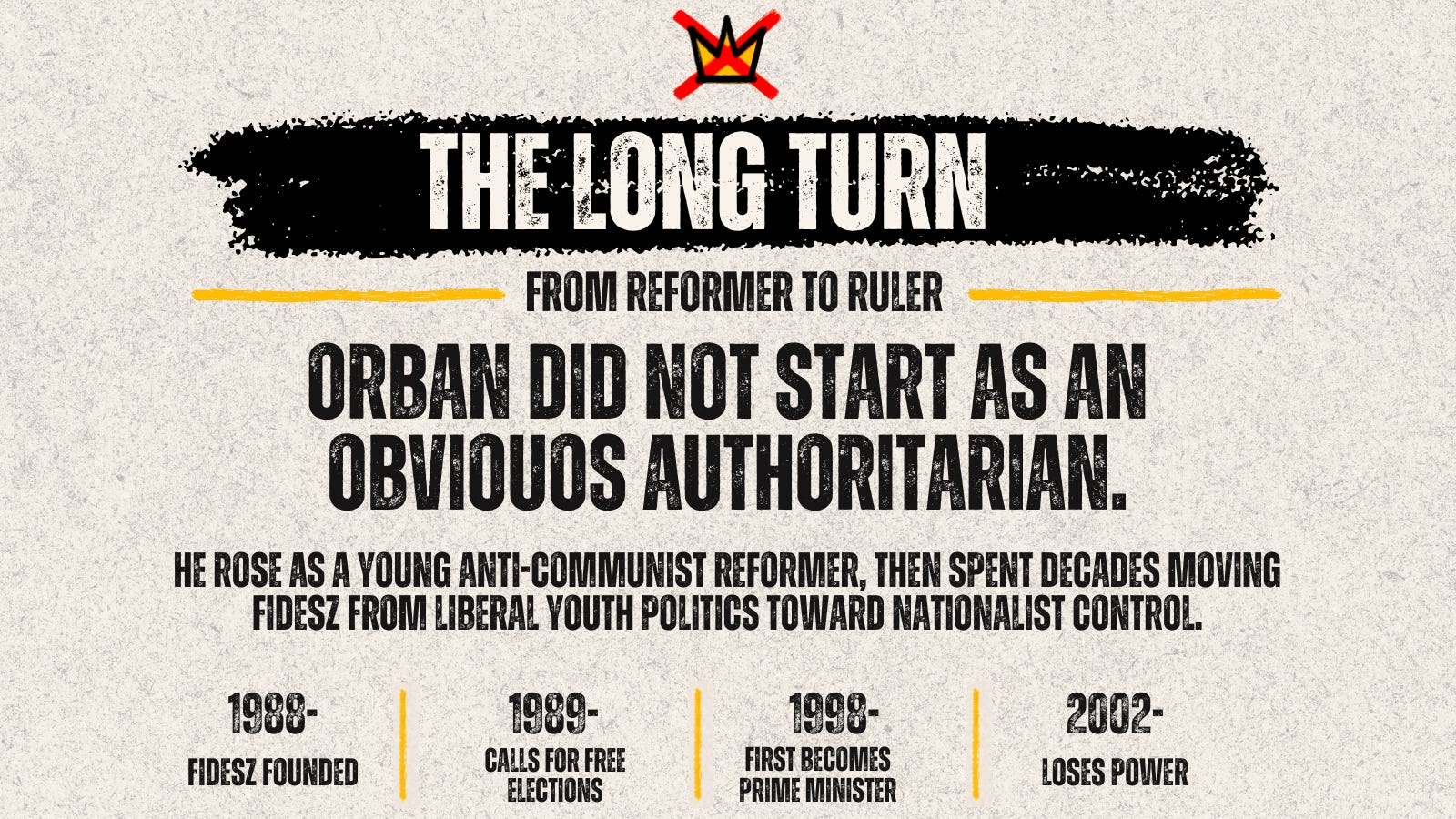
It didn’t start out how many people think it did. Orbán began as a young anti-communist liberal, backed in part by a Soros Foundation scholarship, rising through a youth party that originally supported market reforms and European integration. Fidesz began in 1988 as an anti-communist liberal party for young people. Orbán became internationally known in 1989 when he called for free elections and the withdrawal of Soviet troops. His first period as prime minister, beginning in 1998, was more conservative than liberal, but it wasn’t the full authoritarian project that later emerged. That deeper democratic hollowing accelerated after his return to power in 2010 with a two-thirds parliamentary majority.
What happened, happened in stages.
The Long Turn
1988: Fidesz is founded as an anti-communist, liberal youth party. Promoting market reform and European integration, and even restricts membership to people under 35. Orbán is one of its founders.
1989: Orbán becomes nationally known as a young dissident after publicly calling for free elections and the withdrawal of Soviet troops from Hungary. At this point, he is widely seen as part of the democratic future. Not a warning to start.
1990: He enters parliament as part of Hungary’s new democratic system. Fidesz is still broadly liberal at this stage.
1993: Fidesz begins its decisive ideological shift away from liberalism and toward a civic-national conservative identity. The future strongman project began with a reorientation of the party.
1998: Orbán becomes prime minister for the first time. His government still pursued Hungary’s EU membership. The later “illiberal state” was not fully built yet.
2002: He loses power. When Orbán returned in 2010, he came back determined not to be vulnerable in the same way twice.
The Authoritarian Timeline
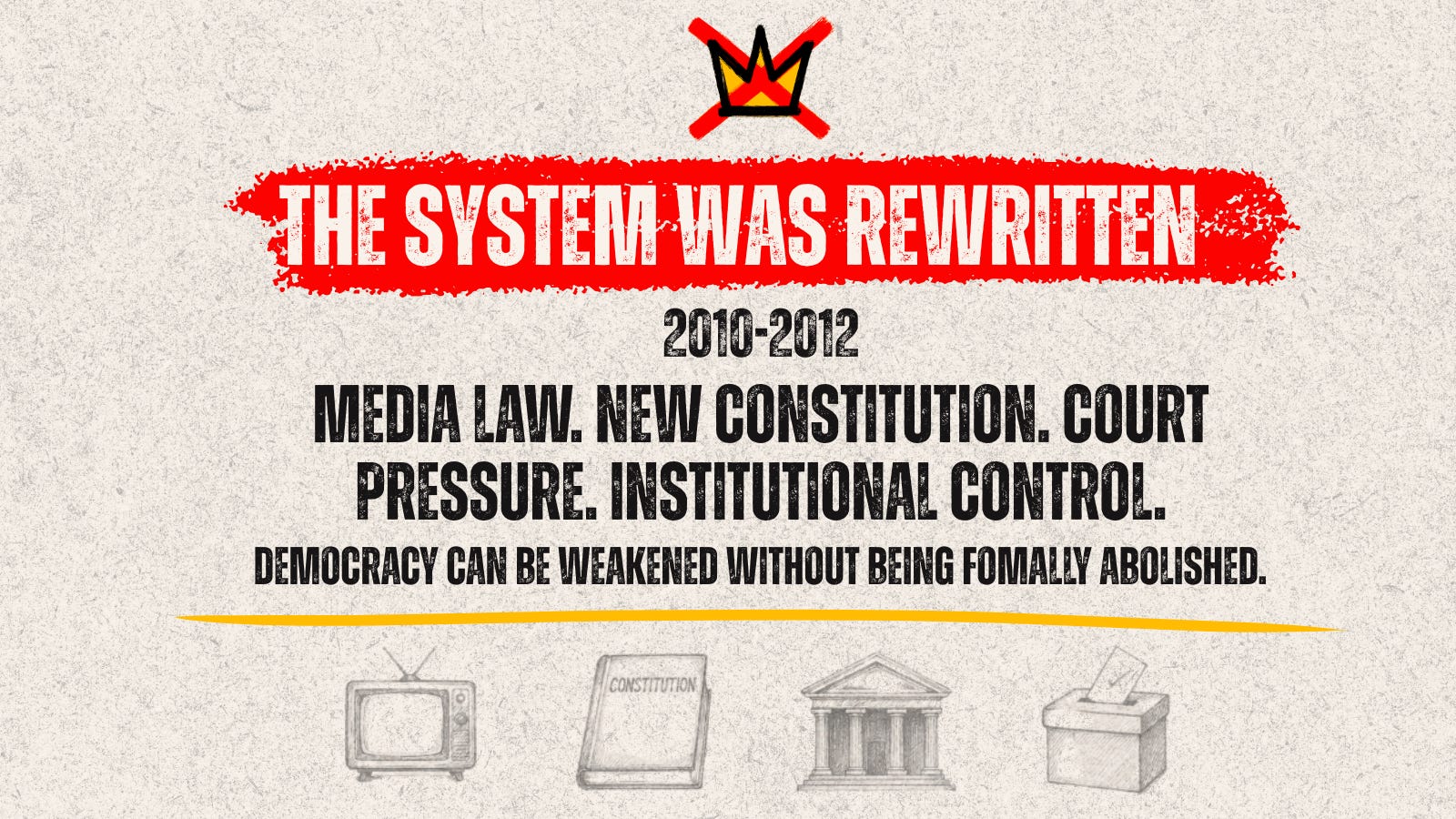
2010: Orbán returns to office with a two-thirds parliamentary supermajority. That gives him the power to rewrite rules. By the end of the year, Hungary passes a sweeping new media law that draws sharp criticism in Europe because it expands state control over media oversight and opens the door to punishment for coverage deemed “unbalanced.”
2011: Orbán’s government adopts a new constitution, the Fundamental Law, without opposition participation. Armed with its two-thirds majority, his government also changed hundreds of laws, rewriting the constitutional frame and making the rest of the system answer to him.
2012: Hungary faces EU legal action over laws involving the judiciary, the central bank, and data protection. A forced-lower judicial retirement age pushes out many judges, and even when parts of that move are later struck down, the institutional disruption is already underway. Courts don’t need to be abolished to be weakened.
2013: Electoral rules and political conditions continue to shift in ways that help entrench Fidesz. From the outside, these years can look less dramatic, but later retrospectives describe this entire period as one of systematic change to the rules and institutions.
2014: Orbán wins again and keeps the power to keep reshaping the system. He says openly that he wants to build an “illiberal state.” By then, what many critics had already concluded becomes explicit. He is no longer merely governing conservatively but arguing against liberal democracy as the organizing principle of the state.
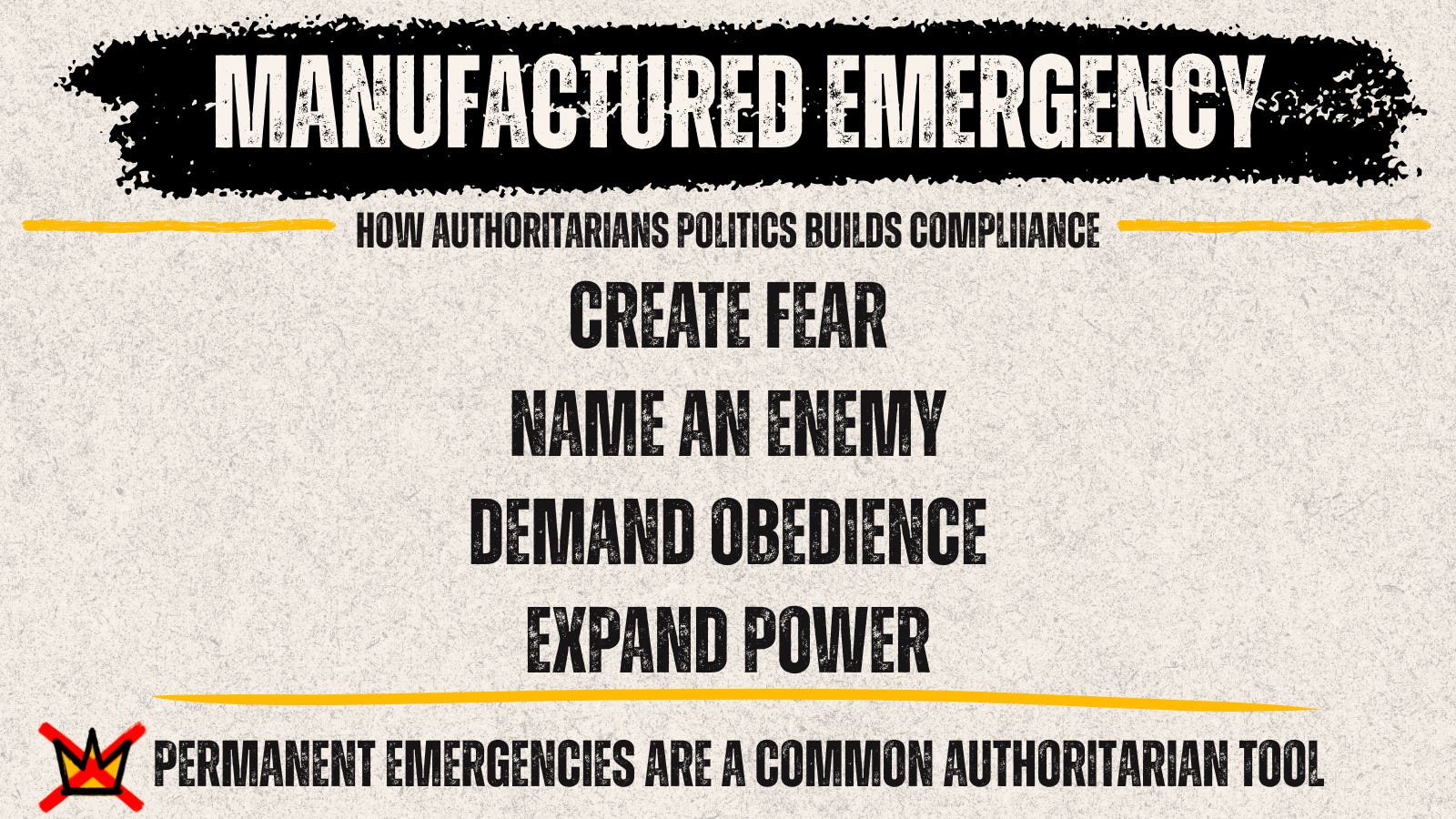
2015: During Europe’s migration crisis, Orbán hardens his political identity around nationalist border politics. This becomes a central way of power, to create a permanent emergency, then use that emergency to justify a harder state, a more fearful public, and a more obedient political culture. (Step 2 in the 7 Step Strategy that Authoritarians use to take over)
2016: One of Hungary’s biggest opposition newspapers, Népszabadság, is abruptly shut down. Human Rights Watch described it as Hungary’s biggest opposition daily and linked the closure to a larger environment of political pressure and shrinking press freedom. By this point, state media purges and pressure on independent outlets continued.
2017: Orbán’s government targets civil society more aggressively. A law requires NGOs receiving significant foreign funding to register and label themselves accordingly, while the so-called “Lex CEU” threatens Central European University, the institution founded by George Soros. Orbán, once helped by Soros funding, now builds power in part by turning Soros into a political villain.
2018: Orbán wins again. Open Society Foundations leaves Budapest, citing an increasingly repressive political and legal environment. CEU is effectively forced out. Dozens of pro-government outlets are folded into the Central European Press and Media Foundation, or KESMA, which the International Press Institute described as an immense pro-government media portfolio of approximately 500 outlets. Parliament also passes the “Stop Soros” package, which criminalizes some forms of aid to asylum seekers. His ecosystem control: media, universities, NGOs, migration law, all moving together.
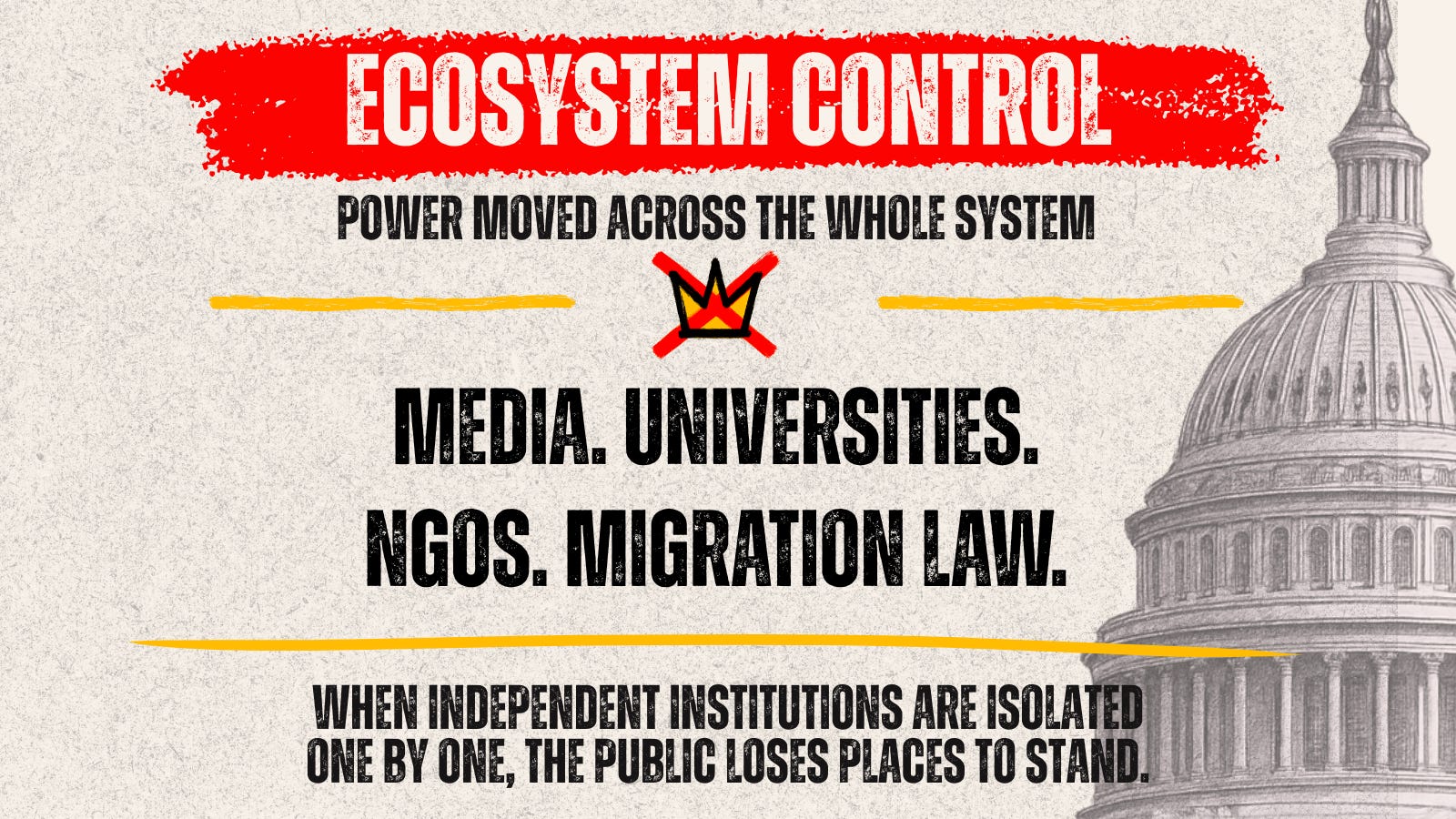
2019: By now, the earlier changes have matured into a governing model. Independent media is thinner, civil society stays under pressure, and Orbán’s system no longer depends on one law per year. After enough capture, maintenance becomes easier than takeover. Reporters Without Borders described the level of media control by the government as “unprecedented in an EU member state.”
2020: The pandemic becomes an opening for one of Orbán’s most significant expansions of authority. Human Rights Watch warned that emergency legislation allowed rule by decree for an open-ended period and created harsh new penalties around so-called false or distorted information.
2021: Hungary passes its anti-LGBT “child protection” law, banning the “portrayal” or “promotion” of LGBT content to minors. Human Rights Watch describes it as part of the government’s broader scapegoating on the LGBT community.
2022: Orbán wins again, but the cost becomes harder to hide. The EU suspends approximately €6.3 billion in funding over rule-of-law concerns tied to corruption and judicial independence. Orbán’s model was concrete enough to trigger financial punishment from the European Union.
2023: The clash with Europe continues. Some funds are later unfrozen, but legal and political fights over Hungary’s democratic backsliding remain active.
2024: The structure still holds, but strain is visible. The longer an “illiberal” system lasts, the more it depends on people accepting it as normal, not just making dissent harder but making people feel tired enough to stop imagining reversal. By 2024, the public mood is clearly shifting. Magyar’s eventual victory was driven in part by economic stagnation, healthcare frustrations, inflation, and years of tension with the EU.
2025: Hungary deepens its anti-LGBT crackdown again, this time with a law banning Pride and similar public events. Human Rights Watch calls it a draconian law that outlaws public support for LGBT. Thousands protest in Budapest. Even after years of erosion, people are still willing to take to the streets when the line is crossed again.
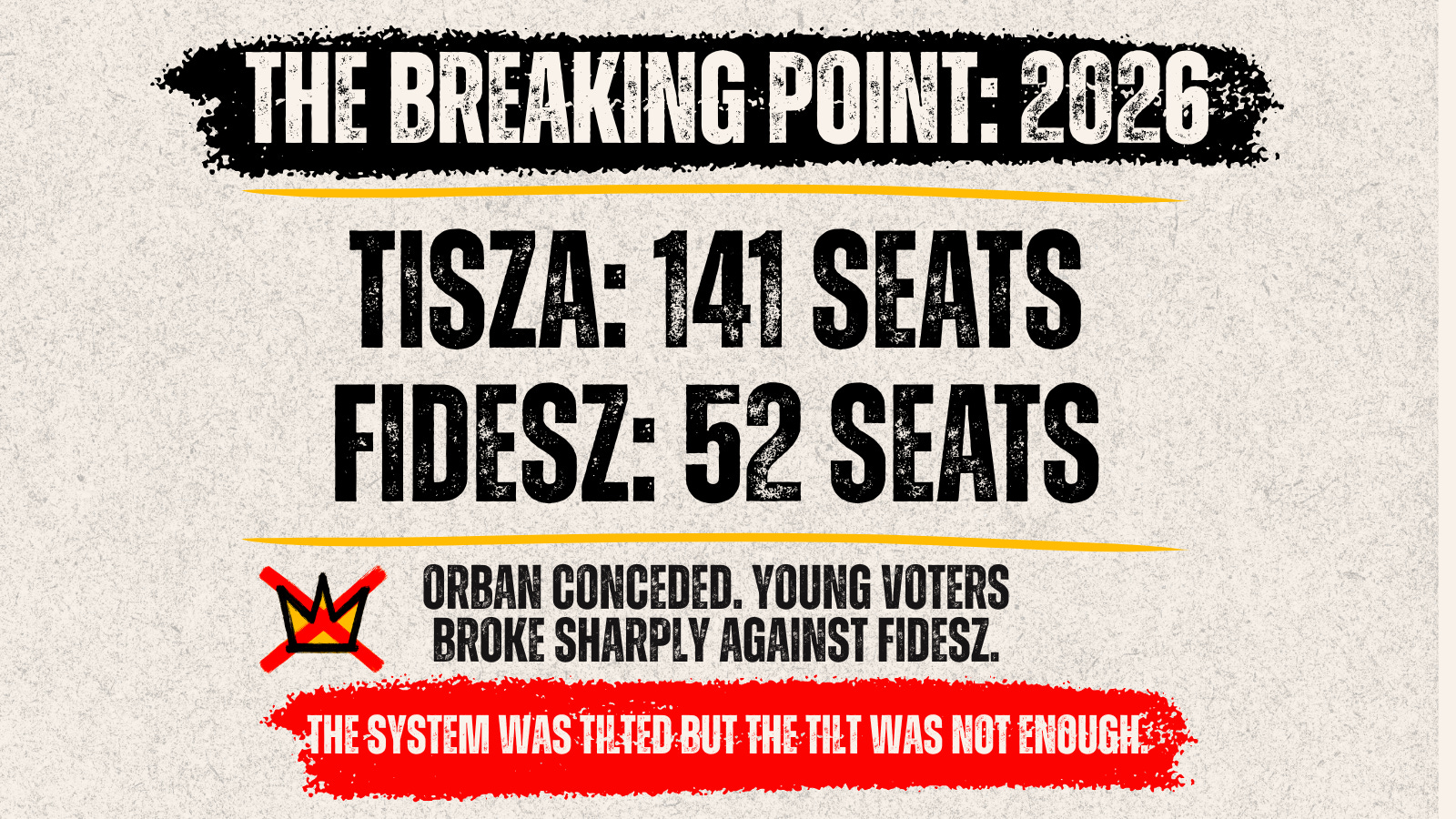
2026: The breaking point. Orbán is ousted after 16 years in power. Voters turned out in extraordinarily high numbers, and after the final count, Péter Magyar’s Tisza party secured 141 of Hungary’s 199 parliamentary seats, giving it a two-thirds supermajority. Orbán’s Fidesz was reduced to 52 seats. Younger voters were especially decisive, with Fidesz performing disastrously among voters aged 18 to 29.
How Hungarians Broke Free
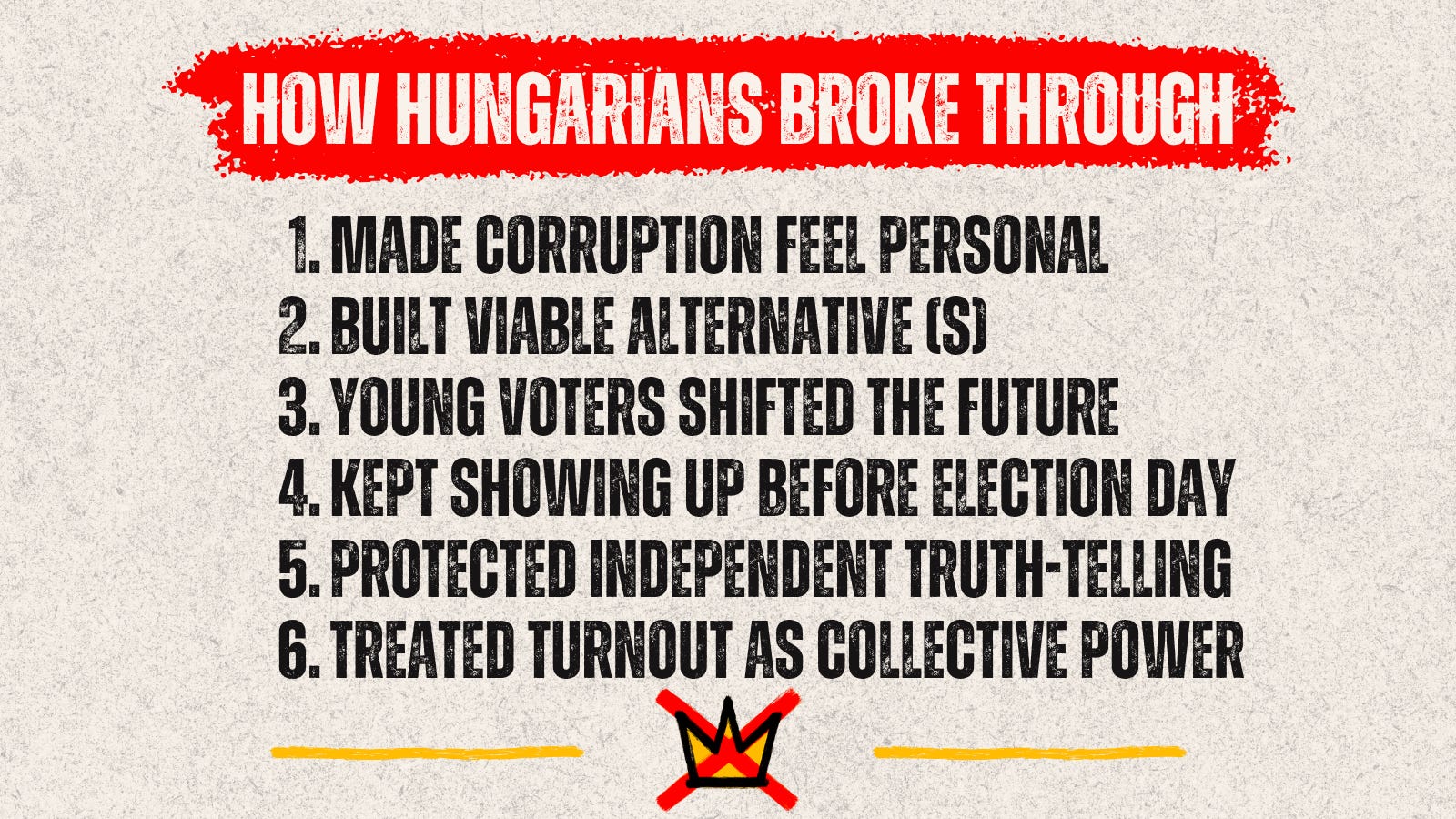
First, they made corruption personal.
Orbán’s system had long been criticized for cronyism, media capture, and rule-of-law erosion, but this corruption doesn’t always move people. More Hungarians began connecting the system to their own daily lives such as stagnant wages, strained hospitals, rising costs, neglected public services, and the sense that a small circle around power was doing very well while people were told to be patient. Magyar pledged an anti-corruption drive and economic revival after Hungary’s economy had been near stagnation for three years.
When someone’s grandfather waits eight months for a surgery that an Orbán ally’s family member gets in a week, corruption becomes personal. That’s what happened across Hungary.
Second, the opposition gave people drive.
People needed somewhere to put their frustration. Magyar’s Tisza party became the resistance because it looked viable. Authoritarian-style politics depends on making opposition feel useless and to believe that every alternative is just as corrupt and broken, so why bother. Once people believe there is a real alternative, fear begins to lose weaken.
Magyar is not a left-wing figure. He is center-right, a former Fidesz insider who turned against the system he once worked within. This was a broad democratic rejection of corruption, stagnation, media capture, and exhausted strongman rule.
Third, young voters changed what would be tolerated of the country.
Independent polls showed more than 60% of voters under 30 supporting Tisza, compared with only 15% supporting Fidesz. These were voters who had come of age entirely under Orbán. They had never known a different kind of politics, and they still chose a different kind of politics.
Younger voters are often described as unreliable or disengaged. But many are not apathetic. They just need politics that feels honest enough to trust, practical enough to mean something, and urgent enough to join.
Fourth, people kept showing up before election day.
Hungarians protested attacks on civil society, universities, media, and LGBTQ rights. When Hungary passed a 2025 law banning Pride and similar events, thousands gathered in Budapest to protest. It reminds people they are not alone. This tells the state that fear has limits.
Fifth, independent media and civil society survived long enough to make a difference.
Orbán’s media system was enormous. Reporters Without Borders described Hungary’s media market as heavily concentrated under the pro-government KESMA foundation, which brought together roughly 500 national and local media organizations. An estimated 80% of the country’s media landscape was under pro-government control.
Independent media didn’t disappear entirely. A captured information environment is dangerous, but it’s not the same thing as total silence. Every surviving outlet, journalist, local organizer, civic group, and truth-teller helped preserve a piece of democratic reality until it could become the foundation for something larger.
Sixth, voters treated turnout as power.
Authoritarian politics wants people to believe the system is rigged, voting is pointless, opposition is weak, and nothing will change. However, Hungary’s voters answered that with record turnout because voting can still become a mass act of refusal when enough people use it together.
A rigged carnival game is designed so you never win. But if every person in line walks away from the booth at the same time, the guy running the game doesn’t have a show anymore. Orbán’s system depended on participation, on people showing up to a game he had tilted. When they showed up and played against his tilt in overwhelming numbers, the tilt wasn’t enough.
What Hungary Teaches
It begins with legal language, regulatory boards, constitutional amendments, friendly media mergers, pressure on universities, smears against NGOs, manufactured moral panics, emergency powers, quiet fear, and public exhaustion. Over time, people begin adjusting to each new line crossed because each line is presented as temporary, necessary, patriotic, or protective. Gradually enough that many people keep telling themselves it’s an overreaction to call it what it is.
None of this made Orbán unbeatable. Even if he built a system to feel unbeatable. He spent years manipulating institutions, narrowing media space, politicizing identity, and making the opposition look futile. And still record turnout came. Younger voters broke away. A broad appetite for democratic repair emerged. And the man who spent years teaching Hungary to fear pluralism lost his power.
Hungary still has work to do.
The damage will not be easy to undo.
The new government is talking about constitutional reform, term limits, and restoring democratic norms, but rebuilding after institutional capture is not usually fast. Poland’s experience after its own democratic recovery in 2023 showed that institutional repair is measured in decades.
Still, the result matters because even a long-running illiberal project can be challenged, rejected, and reversed.
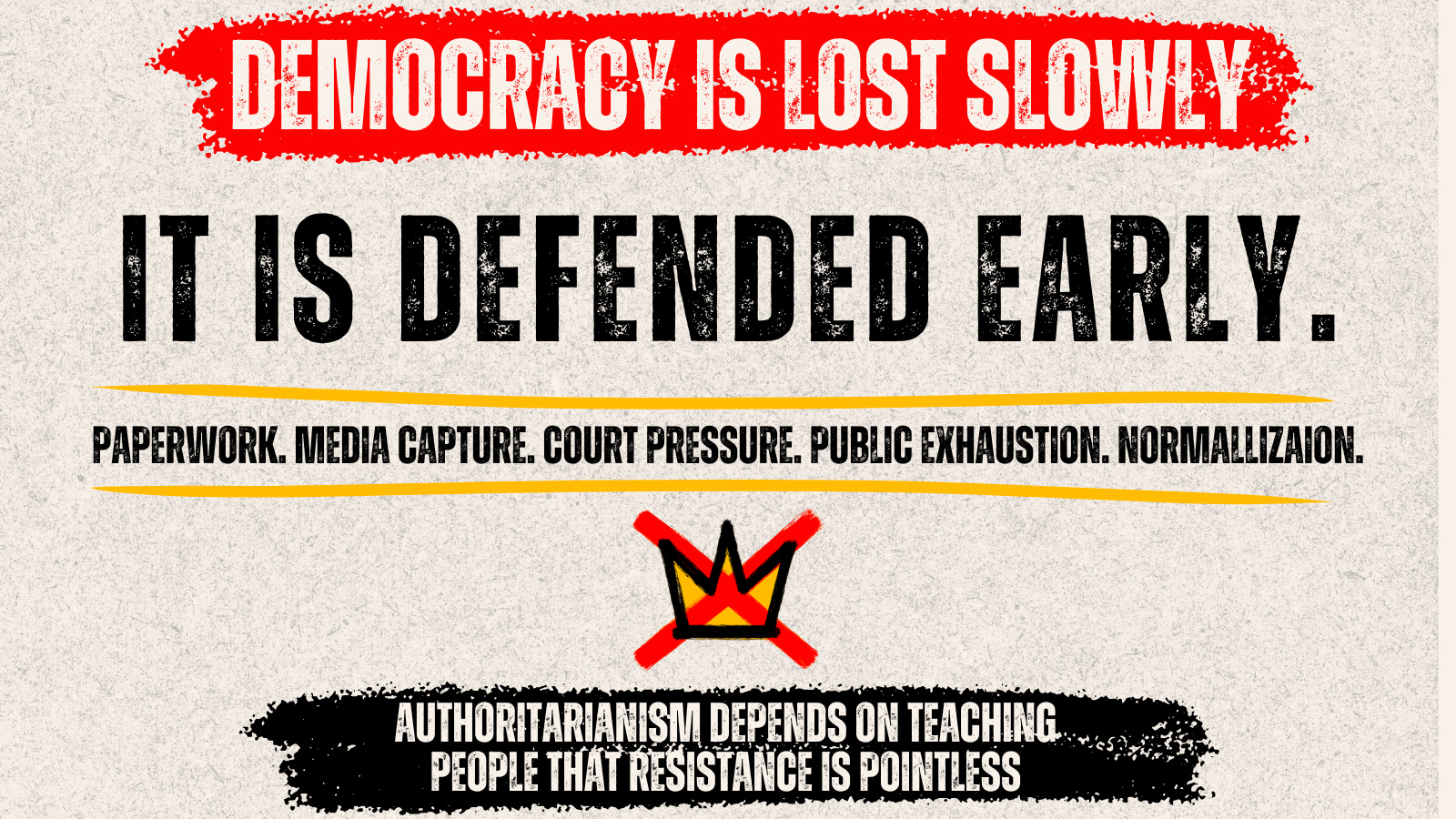
Democracies can be lost in paperwork, media capture, judicial weakening, and public numbness. Democracy is defended by telling the truth early, naming the dysfunction clearly, refusing normalization, and continuing to act before the damage feels irreversible.
Q&A: How Orbán Kept Winning
Hungary’s election raises a few obvious questions. How did Orbán stay in power for so long, why did voters keep backing him, and what finally changed?
Why did people keep voting for Orbán for so long?
Short answer: He gave voters a story about protection.
Orbán combined nationalism, cultural grievance, anti-immigrant politics, anti-LGBT messaging, economic benefits, patronage networks, and attacks on outside “enemies” like Brussels, George Soros, NGOs, universities, and independent media. Orbán’s messaging promoted hostility toward migrants and LGBTQ rights, distrust of the European Union, and conspiracy claims about George Soros.
The takeaway: Authoritarian politics often survives by convincing people that the leader is not attacking democracy. He is “defending the nation.”
How did he keep winning if the system was so damaged?
Short answer: The system was tilted, not abolished.
Orbán kept elections, but his government changed rules, expanded pro-government media, weakened institutional checks, and used state power in ways that benefited Fidesz. Human Rights Watch found that government-collected personal data was repurposed for Fidesz campaign messaging in 2022, contributing to an unequal electoral field.
The takeaway: Modern authoritarianism does not always cancel elections. Like this example, it sometimes keeps them while weakening the conditions that make elections meaningfully fair.
Was Hungary still a democracy under Orbán?
Short answer: It still had elections, but it was no longer a healthy liberal democracy.
Hungary still had opposition parties, courts, protests, and some independent media. But rule of law, media pluralism, judicial independence, civil society, and minority rights were weakened over time. Freedom House rates Hungary “Partly Free” and says Fidesz pushed through constitutional and legal changes that consolidated control over independent institutions.
The takeaway: Democracy can erode without formally disappearing.
How did Orbán go from pro-democracy reformer to authoritarian ruler?
Short answer: Gradually, then structurally.
Orbán began as an anti-communist liberal, but Fidesz shifted right in the 1990s. After losing power in 2002, Orbán returned determined not to be politically vulnerable again. In 2010, his two-thirds majority gave him the power to redesign the system around Fidesz. Oxford’s overview of EU democratic backsliding describes Hungary’s illiberal project as involving centralization of power and limits on judicial, media, and civil-society independence.
The takeaway: Democratic erosion usually comes from elected leaders who decide to change rules than keep competing under them.
Why was media capture so important?
Short answer: It controlled the political reality many voters lived in.
Orbán’s allies built a vast pro-government media ecosystem while independent outlets were pressured, bought, weakened, or marginalized. Reporters Without Borders says Hungary’s media market became heavily concentrated under the pro-government KESMA foundation, which brought together about 500 media organizations, and that Fidesz controlled about 80% of the country’s media.
The takeaway: Propaganda is powerful when it doesn’t really feel like propaganda.
Why did young voters turn so sharply against him?
Short answer: They judged their leader by their future, not his past.
Many young Hungarians grew up entirely under Orbán. Younger voters were concerned about corruption, housing, public services, poor prospects, and rising emigration, while Fidesz was backed by just 8% of voters ages 18 to 29 in one Median survey before the election.
The takeaway: Authoritarian systems hold older voters through nostalgia and promises of stability. Younger voters are more likely to ask whether the system offers mobility, freedom, and a livable future.
Why did people finally turn against him in 2026?
Short answer: The gap between propaganda and daily life became too wide.
Economic stagnation, healthcare frustration, inflation, corruption, strained public services, and Hungary’s isolation from the European Union made Orbán’s image as protector harder to sustain. Magyar’s victory triggered hopes for a reset in EU ties and the possible release of EU funds suspended over rule-of-law concerns.
The takeaway: The official story no longer matched their lived reality.
Why did voters choose Péter Magyar if he was a former Fidesz insider?
Short answer: He became a viable drive for change.
Magyar’s insider status made him complicated, but it also helped him reach disillusioned conservatives, former Fidesz supporters, and voters who wanted change without simply returning to the old opposition. Tisza was identified as center-right and says Magyar defeated Orbán in a landslide while pledging to restore democratic institutions and the rule of law.
The takeaway: Anti-authoritarian coalitions are often broad and imperfect. Democratic repair may require defectors, moderates, progressives, conservatives, organizers, journalists, and voters moving together sometimes for different reasons.
Does this mean Hungary is fixed now?
Short answer: No.
Winning an election removes a ruling party from power. It does not automatically repair captured courts, media structures, public institutions, corruption networks, or years of political distrust. Magyar’s two-thirds majority may make it possible to undo many Orbán-era policies, but institutional restoration still has to be carried out after the election.
The takeaway: Democratic recovery has 2 stages. Defeating the authoritarian party electorally, then rebuilding the institutions it damaged. The second stage is slower and harder.
What is the biggest lesson for Americans?
Short answer: Authoritarianism depends on us believing the outcome is already decided.
Orbán’s system used media capture, institutional pressure, fear politics, scapegoating, and exhaustion to make opposition feel pointless. Hungary’s election shows that inevitability is a political tool.
The takeaway: The antidote is early pattern recognition, independent media, turnout, youth engagement, civil society, broad coalitions, and refusal to normalize democratic erosion. Hungary’s election does not tell us to relax. It tells us not to surrender to inevitability.
Next in This Series: Turkey, how a crisis became a permanent emergency.
Sources
2026 Hungarian parliamentary election
Magyar’s parliamentary majority in Hungary increases after final count
Hungary’s Orbán concedes after Magyar’s projected supermajority win
Peter Magyar wins Hungary election, unseating Viktor Orbán after 16 years
Hungary’s Magyar announces ministers after landslide election win
Viktor Orbán | Biography, 2026 Election, Ideology, & Facts
Hungary: Controversial New Media Law Defended by Government
Hungary: Media Law Endangers Press Freedom
Hungary: Media Freedom Under Threat
Viktor Orbán’s Government and European Reaction
Hungary’s Biggest Oppositional Daily Shut Down
Hungary: Editor’s Sacking a Blow to Press Freedom
The Open Society Foundations in Hungary
Hungary dismantles media freedom and pluralism
Hungary’s Orban Uses Pandemic to Seize Unlimited Power
Hungary’s President Should Veto Anti-LGBT Law
Rule of law conditionality mechanism: Council decides to suspend €6.3 billion
Freezing EU funds: An effective tool to enforce the rule of law?
Hungary Bans LGBT Pride Events
Younger Hungarian voters spurn Orbán, some say they will leave if he is re-elected
Hungary | Reporters Without Borders
Hungary: New Government Needs to Restore Rule of Law
Most excellent writing, thank you. I used to live and work in the former Soviet Union and have been to Russia and Hungary, as well as Poland a few other places in Eastern Europe and Hungary is so beautiful, but I had no idea about the politics at the time so I’m glad they’re making changes. We need to take their lead and kick our king out and start over!!
Authoritarian systems survive by making themselves feel inevitable.
That is why Hungary matters. The election did not prove the damage was easy to undo. It proved the system was never as permanent as it trained people to believe.