

This is the fourth installment of a series examining how democracies erode from within by examining specific countries that have gone through the process. Previously, we reviewed Turkey’s Warning: The Emergency Never Ended.
Help us grow our social media presence so we can reach more people, this channel is dedicated to No Kings News and Media. Follow us on Instagram:
On the night of October 17, 1945
a crowd ,that some historians place in the hundreds of thousands, filled the Plaza de Mayo in Buenos Aires. They had come to free a colonel.
Days earlier, Juan Domingo Perón had been arrested by his own military rivals. They feared his growing influence, especially among Argentina’s working class, and removed him from the government before his movement could grow stronger.
Perón’s rivals thought his arrest would weaken him. Instead, it revealed how strong his support had become. Workers left their factories, poured into Buenos Aires from the industrial suburbs, and packed the Plaza de Mayo. They stayed in the Plaza until the government agreed to release him.
That evening, Perón stepped onto the balcony of the Casa Rosada, the pink presidential palace, and spoke directly to the crowd, with his address broadcast across the country by radio.
Four months later, he won the presidency in a national election that ended the fraud-marked politics of Argentina’s “Infamous Decade,” the period that followed the 1930 coup.
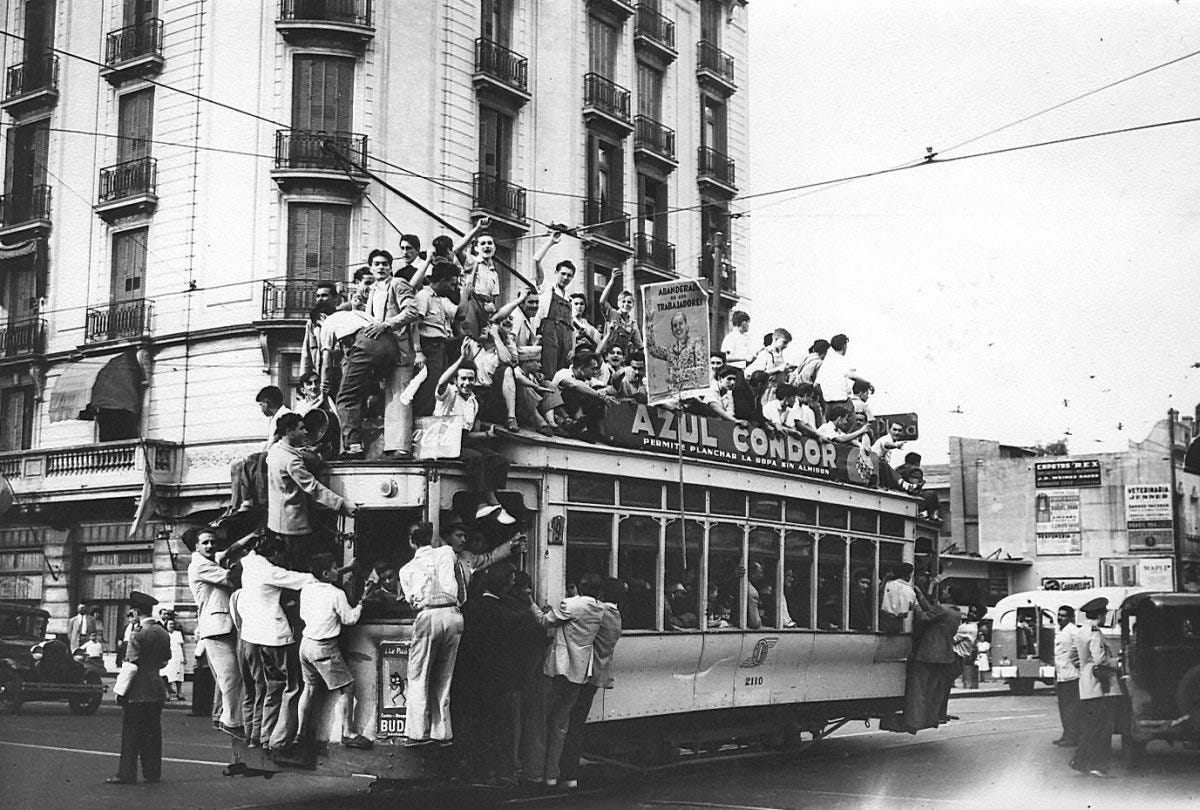
The people in that plaza didn’t think of themselves as supporting a politician. They thought of themselves as the reason a politician existed at all.
Eighty years later, in April 2026
the same building was at the center of a different scene.
President Javier Milei’s government blocked credentialed journalists from entering the Casa Rosada, shuttering a press room reporters had used for decades. Authorities closed corridors inside the building and installed frosted glass on the windows. Milei had made hostility toward the press a daily political performance, repeatedly amplifying the slogan “we don’t hate journalists enough” and attacking reporters as enemies rather than treating them as a check on power.
The bond Perón forged in that plaza, between a leader and a public that could no longer separate his cause from its own, never fully left Argentine politics.
It’s the most durable thing he built, more durable than any law, and it’s worth understanding precisely because it’s the hardest part of the pattern to see while it is happening to you.
Argentina in the early 1940s was not a failed state…
At the beginning of the twentieth century, Argentina had been among the wealthiest countries in the world by GDP per capita, a nation of immigrants, grain exports, cattle wealth, and a large, growing working class that had been shut out of political power by landowners and business interests centered in Buenos Aires.
When a military government took power in a 1943 coup, Perón, an army colonel who had served abroad and observed European fascism firsthand, became one of its key figures. He took a position almost no one else wanted, the Secretariat of Labor and Welfare, and turned it into one of the most powerful offices in the country.
What he did was straightforward and genuinely popular. He backed unions, raised wages, expanded benefits, and gave industrial workers a seat at a table that had never had a chair for them. By the time those nervous officers arrested him in 1945, they were not facing a politician. They were facing a movement that believed he was theirs.
Perón won in 1946, won reelection in 1951, and governed until the military forced him out in 1955. The arc of those years follows a sequence this series has traced in other countries. The labels are the same, the accent changes.
Step one: win power, then change what power means
Perón didn’t seize the presidency. He was elected, repeatedly, and the elections were real in the most basic sense that more people voted for him than against him. His rise was rooted in mass support from workers who had been ignored, underpaid, and excluded from national power.
This is part of what disarms people, and Argentina shows us why. A leader who arrives by genuine popular vote carries a special kind of protection. Every later move can be defended as the will of the people, because at the start, demonstrably, it was.
The trouble begins when winning an election stops being a way to hold power for a term and becomes a mandate to rebuild the rules so the term needs not to end.
In 1949, Perón and his allies organized a constitutional convention and rewrote the country’s founding document. The new constitution expanded social rights, which was popular and, in many respects, genuinely progressive. However, it also allowed Perón to run again by changing the rules around presidential reelection.
Think of a basketball game where one team is up by thirty at halftime. That is a lopsided score, but it is still a game, because both teams play the second half under the same rules and the clock runs out for everyone. Now imagine the winning team, at the break, gets to rewrite the rules completely… their basket counts double, the clock stops only for them, and there is no final buzzer unless they call for one. The score at halftime doesn’t even matter anymore. The game is no longer a fair game.
That’s what changing reelection rules does inside a democracy. Perón had won under one set of rules and then changed the rules that made winning temporary.
Step two: a crisis is always available
Perón did not need to manufacture one dramatic emergency the way some leaders in this series did. He inherited a permanent one, and he understood how to keep it alive.
Argentina’s economy ran hot and cold, and every downturn, shortage, labor fight, and political challenge could be framed the same way: enemies of the people were sabotaging the people’s government:
The oligarchs
Foreign capital
The press that served them
The crisis was hardly an event with a date, it was a mood the government could summon whenever it needed cover, and a population that already believed it had been robbed for generations was primed to accept it.
The usefulness of a crisis is that it reconstructs how people see everything.
Once the country is understood to be under siege, opposition is no longer disagreement. It’s collaboration with the siege.
Step three: name the scapegoat
Every movement that runs on grievance needs a face to attach the grievance to, and Perón’s Argentina had a ready supply.
The landed oligarchy. The “vendepatria,” the sellouts accused of serving foreign interests over Argentine ones. The independent press, recast not as a watchdog but as a paid agent of those interests.
When the government finally moved against La Prensa, one of the most respected Spanish-language newspapers in the world, the formal accusation mattered less than the category. The paper was now portrayed as anti-Argentine.
Step four: expand executive power
The 1949 constitution did much more than open the door to Perón’s reelection.
It strengthened the hand of the executive and the governing movement against everyone else, and it arrived alongside a steady concentration of authority in Perón.
The Justicialist Party became less an organization than an extension of a single man. Perón, by several accounts of those close to him, didn’t actually want a real party with an independent structure. He wanted a movement that ran through him.
A party can outlast a leader but a movement built around one single man becomes dependent on his instincts, his enemies, his moods, and his survival.
This is the difference between a strong leader and a personalist regime, and it’s easy to miss because it feels like strength. When the institution and the individual become the same thing, the institution loses the ability to correct the individual. There’s no longer anyone inside it whose loyalty is to the thing rather than to the person in power.
Step five: take the courts, then the press
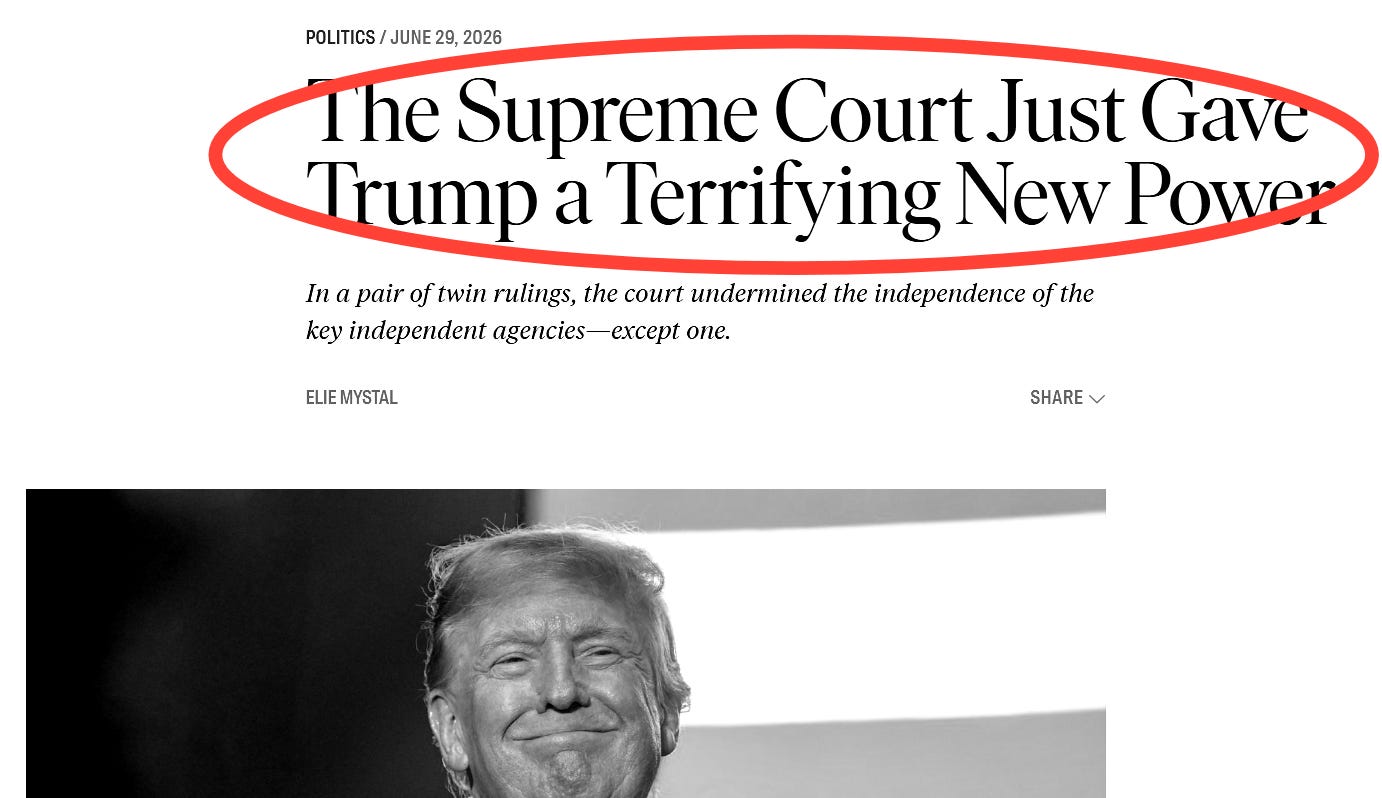
In 1946 and 1947, Perón’s majority in Congress moved against Argentina’s Supreme Court. Four of the five justices were impeached or removed. The official charges focused on their conduct during earlier military-backed governments, but the political logic was clearer, the Court was framed as an obstacle to the popular will.
The result was a judiciary reshaped to fit the government, rather than a court strong enough to check it. Sound familiar….?

Then came the press, and the story of one major newspaper.
La Prensa had published in Buenos Aires since 1869 and was widely regarded as one of the most important newspapers in the Spanish-speaking world. The government didn’t shut it down overnight.
First it rationed the paper’s newsprint, the physical supply of paper it needed to print, then denied access to more. Then a government-aligned newsdealers union refused to distribute it, forcing it to suspend publication in January 1951. When workers tried to enter the plant, violence followed, and a La Prensa employee was killed. A congressional commission seized the paper’s records. In April 1951, Congress voted to expropriate the paper outright and handed it to the Peronist labor confederation. The newspaper was returned to its owner only after Perón fell in 1955.
Imagine a neighbor who decides your security cameras are a problem for him
He doesn’t climb your fence, which would be a crime everyone could see. Instead, he gets the power company to throttle your electricity, then leans on the only company that sells camera batteries to stop selling to you, then has the homeowners association declare your cameras a nuisance and vote to take them. At the end, you have no cameras, and he can say he never touched your property.
That’s essentially how La Prensa was taken. Every move had a legal form or action. The outcome was the silencing of the government’s most powerful critic, accomplished slowly enough that each step looked like a labor dispute or a regulatory matter rather than what the whole thing added up to.
Step six: remove people who might say no
A personalist movement cannot tolerate independent centers of judgment, even friendly ones, and especially not ones with their own legitimacy.
By the early 1950s, the Peronist organization had grown into a system that held enormous power across Congress, the judiciary, provincial offices, and local governments. Membership or loyalty to the movement became, for citizens, a practical advantage and eventually something much closer to a requirement for getting along. The space for someone inside the system to object was steadily closed off by making loyalty the price of belonging.
The institution that finally broke with Perón was one he could not fully absorb. The Catholic Church. It initially supported him, but as he moved against its privileges and independence, the relationship collapsed in 1954 and 1955.
A regime built on personal loyalty will keep eliminating internal dissent until the only opposition left is the institution too large and too independent to swallow, and that institution often becomes the hinge on which everything turns.
Step seven: make it feel normal
The genius of Peronism, and the reason it’s the hardest case in this series to see clearly, is step seven.
By the time Perón had remade the constitution, the court, the press, and the party, none of it felt like a takeover to the millions who supported him. It felt like victory. It felt like the country finally belonging to the people.
A CIA assessment years later described Peronism as having an “almost mystical hold” on Argentina, with followers who treated Perón and his philosophy of social justice with “almost religious fervor.”
Supporters didn’t experience the loss of an independent press as a loss.
They experienced it as their enemies losing.
In other countries, these steps worked by fear or exhaustion that no one quite notices. In Argentina, it worked by love.
The bond was so complete that supporters couldn’t separate their own identity, their dignity, their place in the nation, from their allegiance to one man. To criticize Perón was not to disagree with a policy. It was to attack them.
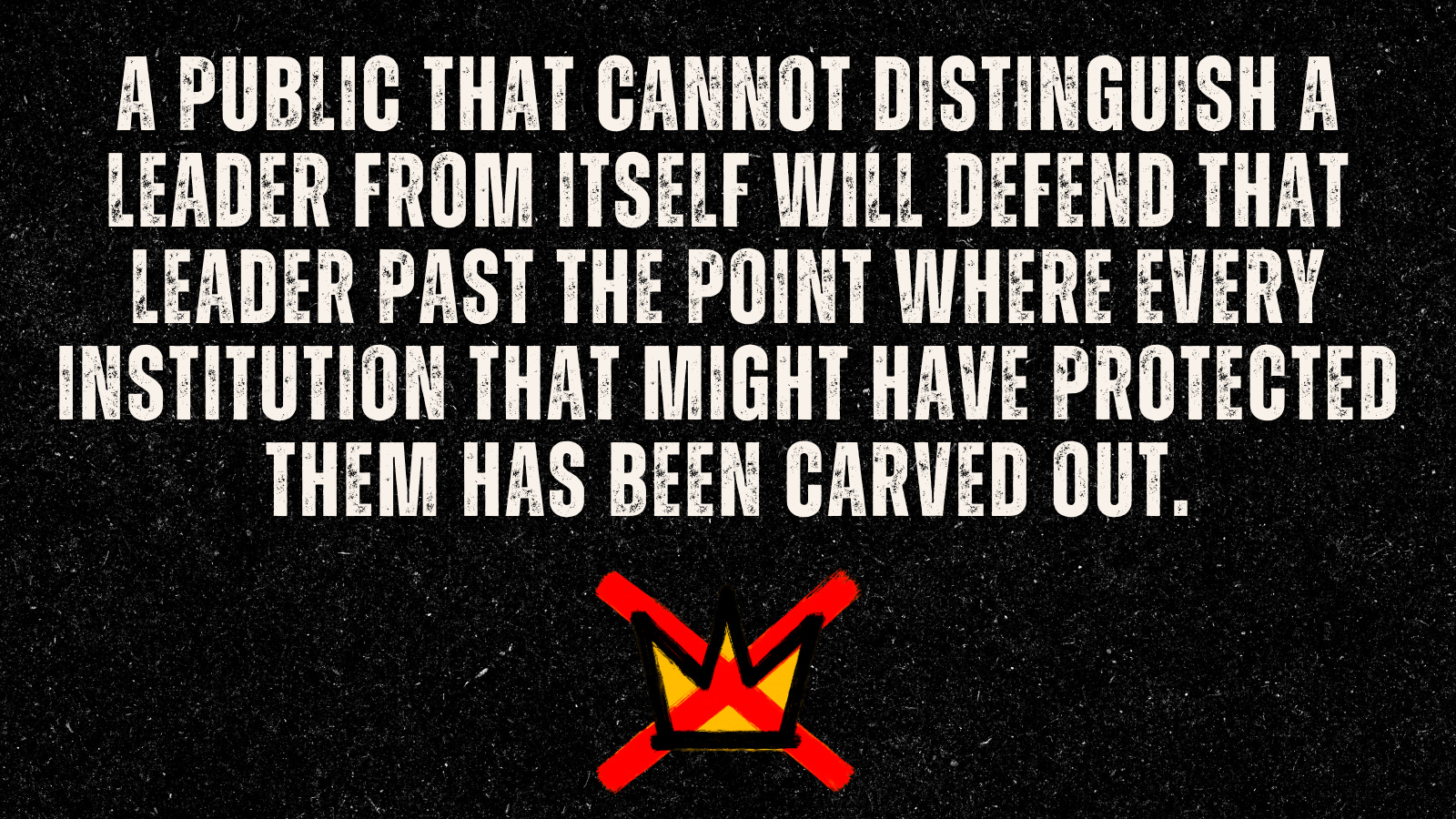
A public that can’t distinguish a leader from itself will defend that leader past the point where every institution that might have protected them has been carved out, because the hollowing never felt like a threat. It felt like win.
The bridge
The temptation with Argentina is to treat it as a museum piece, a black-and-white newsreel from the 1950s. The reason to resist that is that the same building, the Casa Rosada, became the site of a recognizable scene this spring.
In April 2026,
Milei’s government blocked credentialed journalists from entering the Casa Rosada, closing a press room reporters had used for decades.
The government said the restriction was a security measure after footage from inside the building was allegedly recorded with smart glasses. But the move drew condemnation from journalists, press freedom advocates, and lawmakers, and it came after a long public campaign of hostility toward the press. Within roughly a week, the government restored some access, but two TV networks remained barred and new restrictions on reporters movement inside the building stayed in place.
Pressure on the press framed as something other than censorship, dressed up in administrative language, walked back only after broad pushback. It’s step five in a country that has seen this before and remembers it.
The same instinct shows up in how Milei has approached the courts. In February 2025, after failing for months to secure the two-thirds Senate majority required under Argentina’s normal process, Milei attempted to fill two Supreme Court vacancies by presidential decree. Human Rights Watch called the move one of the most serious attacks on judicial independence since Argentina’s return to democracy. A United Nations expert also warned that the appointments bypassed constitutional checks and balances. The Senate later rejected both nominees, effectively nullifying the maneuver, but the attempted bypass still revealed the instinct, when the check would not bend, the executive tried to route around it.
Recently, In June 2026,
Milei signed Decree 467/2026, changing the process for nominating Supreme Court justices. The decree removed the public participation stage that had allowed citizens, universities, professional groups, civil society organizations, and human rights groups to weigh in before the president sent a nominee to the Senate. It also eliminated recommendations that nominees reflect gender diversity, professional specialization, and Argentina’s regional balance.
The government described the move as an efficiency measure, arguing that public scrutiny still exists later in the Senate. Critics described it as a rollback of transparency around one of the most important appointment powers in the state.
Then, only days later, Argentina’s Supreme Court ruled against the Milei government in a major university funding dispute, leaving in place an order requiring the administration to comply with parts of a law it had tried to resist.
American readers do not have to squint to see the connection.
Milei appeared at CPAC in February 2025, where he presented Elon Musk with a chainsaw, the prop that has become a symbol of Milei’s promise to cut the state. At minimum, that moment showed how freely symbols, slogans, and political style now travel across borders.
This all looks familiar:
Attack the press as an enemy rather than tolerate it as a check
Treat courts as obstacles when they rule against power
Push appointments and executive actions as far as the system will allow
And frame independence itself as disloyalty
In the United States, this is visible in hundreds of legal challenges to executive action, in court orders repeatedly blocking or limiting government moves, and in public attacks on judges who rule against the president.
It’s visible when judges and their families face threats after politically charged rulings and it’s visible when the free press is reframed not as an institution to be answered, but as an opposition force to be defeated.
When a significant share of a country’s voters cannot separate their own identity from loyalty to a single figure, criticism of the leader starts to feel like criticism of the supporter. Evidence doesn’t land, because evidence against the leader feels like evidence against the self.
Argentina shows where that road can lead when it’s followed far enough. Not as prophecy, but as history.
What the people did
Perón fell in September 1955, in a military and civilian uprising that called itself the Revolución Libertadora.
It wasn’t democracy reasserting itself though, it was a coup.
The dictatorship that followed shut down Congress, replaced the Supreme Court, intervened in provinces and universities, outlawed Peronist expression, and used state power to suppress the movement it had overthrown. In 1956, the regime issued Decree-Law 4161, banning public Peronist propaganda and symbols. Peronism itself was pushed out of legal politics for years.
Argentina spent the decades between 1955 and 1983 cycling through military and civilian governments, none of them stable, before the country finally returned to constitutional democracy in 1983.
The recovery, when it came, didn’t come from a strongman who saved them from the last strongman. It came from rebuilding the institutions, the elections and the courts and the press, that personalism emptied out. It came from a slow, hard relearning of the difference between supporting a government and belonging to it.
The recent Argentine response carries the memory of all of that.
When Milei locked the press out of the Casa Rosada, the pushback came from journalists, lawmakers, press freedom advocates, and civil institutions fast enough that the government partially reversed itself within days.
In October 2025, Argentina’s lower house advanced legislation to curb presidential emergency decree power, part of the same broader fight over whether a president can govern around Congress. The Court was also forced to confront whether decree appointments to the Supreme Court were constitutionally valid before the Senate rejection effectively killed the move.
Argentina, having been here before, has a population that recognizes the early steps.
What Argentina teaches us
The hardest thing to defend is the line between a person and a country.
Argentina shows what happens when that line is erased, and how long it lasts.
Perón has been dead since 1974. The movement he built has governed Argentina for a large share of the years since. The institutions he attacked were rebuilt, broken, and rebuilt again.
A country can rebuild a court. It can return a newspaper to its owner, as Argentina returned La Prensa in 1955. What’s much more difficult to restore is a public’s ability to tell the difference between a person and itself.
Sources and further reading
Encyclopaedia Britannica, Juan Perón
Encyclopaedia Britannica, Peronist movement
Encyclopaedia Britannica, Argentina: Conservative Restoration and the Concordancia, 1930–43
Ohio State Origins, Argentina’s Day of Loyalty and the Birth of Peronism
Our World in Data, Argentina was one of the richest countries in the world at the beginning of the 20th century
Cambridge University Press, Constitutional Change as a Means to Consolidate Power: Argentina 1949
JSTOR, The Argentine Constitutional Revision of 1949
UCI Economics, The Erosion of Checks and Balances in Argentina
TIME Archive, Argentina: Murder at La Prensa
U.S. Office of the Historian, CIA Memorandum: Peronism in Power
Argentina.gob.ar, Decreto/Ley 4161/1956
AP, Argentina’s Milei restores press access to presidency after a ban sparks backlash
Reuters, Argentina blocks journalists from government house citing espionage with smart glasses
Human Rights Watch, Argentina: Milei Undermines Judicial Independence
JURIST, UN expert expresses concerns over Argentina Supreme Court appointments by presidential decree
Human Rights Watch, World Report 2026: Argentina
Reuters, Argentina lower house approves bill curbing presidential decrees
Reuters, Elon Musk wields chainsaw at conservative gathering, gift from Argentina’s Milei
Just Security, Litigation Tracker: Legal Challenges to Trump Administration Actions
Reuters, These judges ruled against Trump. Then their families came under attack
Committee to Protect Journalists, Trump’s first 100 days portend long-lasting damage to press freedom
Excellent piece. The playbook of autocrats for thousands of years. Throw in religion and you have the Pharonic era of ancient Egypt! Dump Trump!!
Excelent!!,and very good piece of journalism
I had lived in Buenos Aires during all those years!